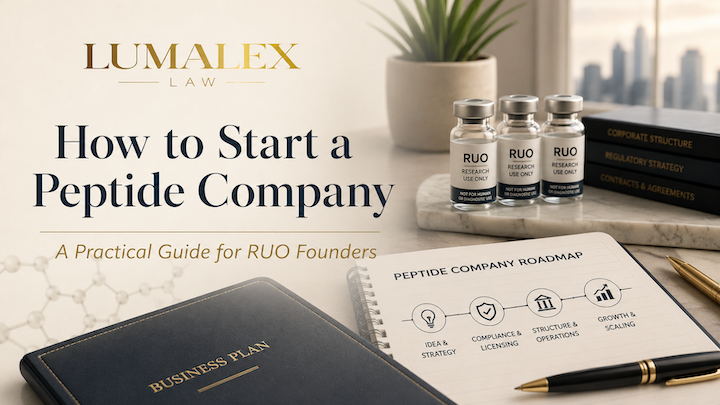
The RUO peptide space has grown quickly over the past few years, and with that growth has come a new wave of founders trying to figure out how to build the business the right way from the beginning.
For many operators, the focus starts with the product: what to sell, where to source it, how to launch the website, and how quickly they can begin taking orders. Those things matter, but they should not come before the legal and operational foundation. In the RUO, or research-use-only, peptide space, the way the company is structured, how products are sourced, what the website says, and how the business handles payments and testing can all affect whether the company is building something sustainable or creating risk from day one.
LumaLex Law has advised RUO companies through formation, supply chain, website compliance, and early operating decisions. If you are researching how to start a peptide company, the playbook is not simply “form an LLC and launch a store.” A compliant RUO peptide company needs structure, documentation, and a clear separation between research-use-only positioning and anything that could imply human use. Here is where to start.
1. Get the Corporate Structure Right
This is one of the most important early steps, and it is also one of the easiest to get wrong.
A single LLC is usually not the right structure for an RUO peptide company. At minimum, founders should consider a HoldCo LLC sitting above separate operating entities, with each subsidiary LLC handling a distinct function of the business.
One entity may hold the IP and brand. Another may handle purchasing and supplier relationships. Another may run the sales side of the business.
That separation is not just administrative. It creates a liability firewall. If a claim arises out of a product issue, the goal is to contain that exposure to the entity that touched the product, rather than allowing it to reach the entity that owns the brand, IP, or other valuable assets.
The best time to set this up is before the company has revenue, not after a problem appears.
2. Lock Down the Supply Chain
Once the entity structure is in place, the next major issue is sourcing.
Most RUO peptide companies source product in one of three ways: direct import from China, a domestic white labeler, or a U.S.-based distributor. Each route has different legal, financial, and operational tradeoffs.
Direct import may offer more control, but it also means the company is the importer of record and directly carries customs, labeling, and testing risk.
A domestic white labeler may shift some of that burden, but it raises its own questions around exclusivity, quality control, and what happens if the white labeler’s compliance falls apart.
A U.S.-based distributor may be the fastest way to get started, but margins are often thinner, and the company becomes more dependent on someone else’s upstream relationships.
Whichever route the business chooses, the product list and supplier obligations should be clearly documented before the founder builds the rest of the business around that supply relationship.
3. Build a Compliant RUO Website
For an RUO peptide company, the website is not just a sales channel. It is often the first place a regulator, payment processor, or opposing attorney will look.
The site needs to make unmistakably clear that the products are not for human consumption. That message cannot live only in a footer disclaimer. The website should avoid implying human use anywhere, including product descriptions, reviews, blog content, imagery, and other marketing materials.
This is where many new companies create unnecessary risk. A site may use research-use-only language in one place, but then undercut that position with product copy, lifestyle imagery, customer reviews, or educational content that suggests human use.
The legal documents also matter. RUO peptide companies need robust Terms and Conditions and a robust Privacy Policy, not boilerplate copied from a template site.
Before launch, the website should be reviewed by counsel. It is much easier to revise website language before the site goes live than to respond to a regulatory inquiry later.
4. Set Up Banking and Payment Processing Early
Banking and payment processing are often among the biggest operational challenges for RUO peptide companies.
Traditional banks and mainstream payment processors may be hesitant to work with businesses in this space. Account shutdowns can happen with little notice, and many operators underestimate how disruptive that can be.
Founders should plan for this early by lining up banking and payment-processing relationships that understand the RUO space. They should also have a backup plan ready before it is needed.
Waiting until a primary processor drops the company can leave the business scrambling at the exact moment it needs stability.
5. Bring In Inventory and Get Independent COAs
Once the structure, supply chain, website, banking, and payment processing are in place, the company can prepare for its first inventory run. Before selling a single unit, the company should obtain an independent Certificate of Analysis for each product. Do not rely only on the supplier’s COA.
Third-party verification helps protect the business if a product’s purity or identity is later questioned. It is also a basic diligence step that regulators, payment processors, and customers may expect the company to have taken.
6. Start Selling Only After the Foundation Is in Place
The final step is the one most founders want to reach first: turning on the store and starting sales. But in the RUO peptide space, selling should come after the foundation is complete. The company should have its corporate structure in place, its supply chain documented, its website reviewed, its banking and payment processing prepared, and independent COAs for its products.
Launching before those pieces are ready may feel faster, but it can create avoidable risk that becomes much harder to fix later.
FAQ
How do you start a peptide company?
To start an RUO peptide company, founders should first build the legal and operational foundation. That includes setting up the right corporate structure, choosing and documenting a supply chain, building a compliant website, securing banking and payment processing, obtaining independent COAs, and only then beginning sales.
What corporate structure should an RUO peptide company use?
A single LLC is generally not ideal. Many RUO peptide companies should consider a HoldCo LLC above separate operating entities, with different subsidiaries handling functions such as IP and brand ownership, purchasing and supplier relationships, and sales.
Why does website compliance matter for RUO peptide companies?
The website is often the first place a regulator, payment processor, or opposing attorney will look. The site should make clear that products are not for human consumption and should avoid language, imagery, reviews, or content that implies human use.
Do RUO peptide companies need independent COAs?
Yes. Before selling any product, an RUO peptide company should obtain an independent Certificate of Analysis for each product rather than relying only on the supplier’s COA.
Why is payment processing difficult for peptide companies?
Traditional banks and mainstream payment processors may be hesitant to work with RUO peptide businesses. Companies should plan early, work with providers that understand the RUO space, and have backup payment-processing options ready.
How to Start a Peptide Company
Starting an RUO peptide company is not just a branding or ecommerce project. It is a regulated-risk business that needs the right legal and operational structure from the beginning.
The strongest companies do not wait until there is a supplier dispute, payment shutdown, product issue, or website compliance concern to get organized. They build the foundation first: corporate structure, supply chain, website compliance, banking, payment processing, and independent testing.
LumaLex Law works with RUO peptide companies on formation, entity structure, supplier relationships, website compliance, and day-one risk management. If you are forming or restructuring an RUO peptide company, contact us to discuss how to build the business correctly from the start.
Disclaimer: The information contained in this article is provided for general informational and educational purposes only and does not constitute legal advice, nor does it create an attorney-client relationship. Research Use Only (“RUO”) products are intended solely for laboratory research and development purposes. RUO products are not drugs, dietary supplements, cosmetics, or food, and are not approved by the U.S. Food and Drug Administration for the diagnosis, treatment, cure, or prevention of any disease or condition. RUO products are not for human or animal consumption or administration under any circumstances. Nothing in this article should be construed as condoning, promoting, encouraging, or suggesting that any RUO product be sold, marketed, distributed, or used for human or animal consumption or for any purpose other than legitimate scientific research. Any individual or entity engaged in the sale, purchase, or use of RUO products is solely responsible for ensuring compliance with all applicable federal, state, and local laws and regulations.