Why Creators Should Be Watching a Gay Dating App’s Telehealth Play

LumaLex Law · October 2026 On September 30, 2026, Grindr signed a deal to buy PurposeMed, the parent of HIV-prevention telehealth brand Freddie, for $250 million: $190 million in cash and $60 million in Grindr stock, plus up to $70 million more if the business hits 2027 targets (Form 8-K). It is the dating app’s […]
Empower, the B Vitamin, and the Word “Pretextual”
LumaLex Law | Dustin Robinson On September 18, 2026, FDA issued a warning letter to Empower Clinic Services, LLC, doing business as Empower Pharmacy, following an inspection of its Houston 503A facility conducted November 3 through 14, 2025. The letter is worth reading in full, because it does something FDA has mostly avoided until now: […]
The Piper Sentencing, Read Carefully — and Why RUO Companies Should Be Evaluating the Telehealth Path
On July 23, 2026, U.S. District Judge Robert J. Jonker sentenced Brandon Piper, 35, of Gobles, Michigan, to 21 months in federal prison. This article is based on the United States’ Sentencing Memorandum filed July 8, 2026 (United States v. Piper, No. 1:26-cr-00018-RJJ, W.D. Mich., ECF No. 20), signed by Assistant U.S. Attorney Stephanie M. […]
Start as an LLC, Convert to a C Corp: The QSBS Basis Play Most Founders Miss

Founder Guide | Entity Structuring & Section 1202 Converting an LLC to a C corporation can reset your QSBS basis to fair market value, turning a $15 million gain exclusion into something far larger. Here are the mechanics, the math, and when it actually works. The Short Version Most founders treat “LLC or C corp” […]
FDA’s Five Peptide Warning Letters: Four Takeaways for RUO Sellers
On August 24, 2026, FDA issued five warning letters to companies selling research-use-only peptides. All five came out of the Center for Drug Evaluation and Research’s Office of Unapproved Drugs and Labeling Compliance. All five charge the same violation: introducing unapproved new drugs into interstate commerce under Sections 505(a) and 301(d) of the Federal Food, […]
Three States, One Message: What Mississippi and South Carolina Just Said About Research-Grade Peptides

And why the standard of care is the real issue in all fifty states, not three By Dustin Robinson, Esq., CPA | LumaLex Law | Peptides · Telehealth · Regulatory Compliance In mid-August 2026, within roughly a day of each other, two states published nearly identical notices about the same product category. The Mississippi […]
Vermont Joins a Fast-Moving Trend: What the State-by-State Crackdown on Private Equity in Health Care Means for MSOs and Telehealth
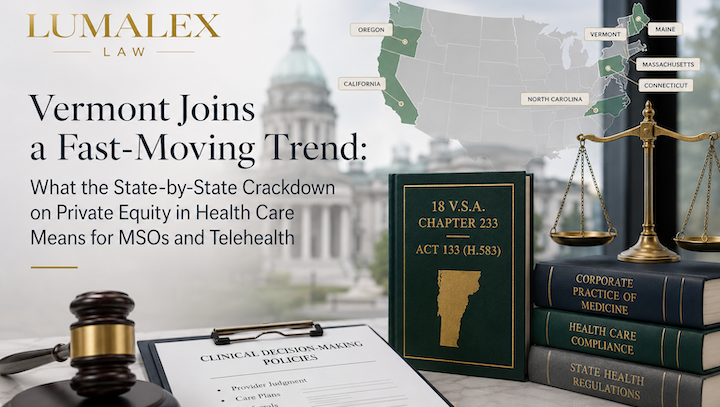
Vermont’s new clinical decision-making law isn’t an isolated event. It’s the latest entry in a wave of state legislation — from California and Oregon to Massachusetts, Connecticut, Maine, Pennsylvania, and North Carolina — that has reshaped the compliance landscape for MSO/PC arrangements, telehealth platforms, and their private equity sponsors since 2025. Understanding Vermont on its […]
The License Holder and the Operator: What Healthcare, Cannabis, and Fintech All Have in Common
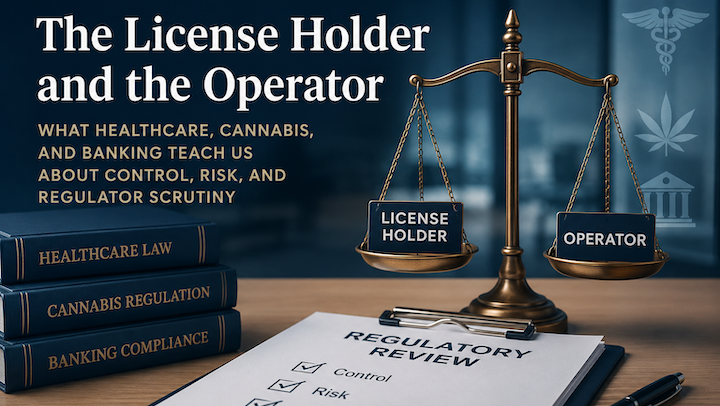
By Dustin Robinson, CPA, Founding & Managing Attorney, LumaLex Law There is a structure that shows up over and over again in the industries we work in, and most people never notice that it is essentially the same structure. A telehealth company cannot own the medical practice, so it forms a management services organization that […]
California Draws a Line Around the “Friendly PC”: What MSO-Backed Healthcare Platforms Need to Know

For years, the friendly professional corporation model has been one of the core structures behind investment in medicine. The basic idea is familiar: a physician owns the professional corporation that employs clinicians and holds the medical licenses. A management services organization, or MSO, sits beside the PC and handles the non-clinical side of the business: […]
Hedging Into Telehealth: What RUO Peptide Companies Need to Know Before Building a Medical Channel
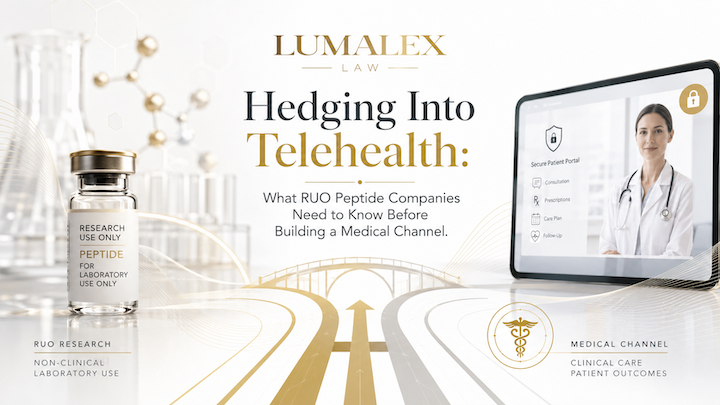
The signal from the top has been consistent: current HHS leadership wants peptide access to move through lawful medical channels, and it has been openly skeptical of the research-use-only market that grew while those channels were closed. The Pharmacy Compounding Advisory Committee meeting on July 23rd and 24th was the first formal step in that […]