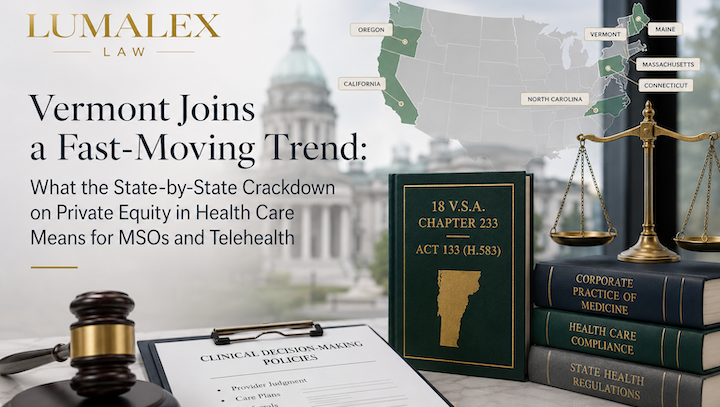
California Draws a Line Around the “Friendly PC”: What MSO-Backed Healthcare Platforms Need to Know

California Draws a Line Around the “Friendly PC” | LumaLex Law

For years, the friendly professional corporation model has been one of the core structures behind investment in medicine.

The basic idea is familiar: a physician owns the professional corporation that employs clinicians and holds the medical licenses. A management services organization, or MSO, sits beside the PC and handles the non-clinical side of the business: billing, marketing, staffing logistics, technology, real estate, capital, and business operations.

A management services agreement connects the two. Ancillary agreements, often including stock transfer restriction agreements or continuity agreements, give the MSO a way to protect the platform if something goes wrong with the physician-owner relationship.

For many investors and operators, those physician-removal rights have long been treated as ordinary risk management. California is now signaling that they may be among the most dangerous provisions in the entire structure.

Over roughly ninety days in the spring and summer of 2026, the California Attorney General moved on three fronts. In late March, his office filed an amicus brief in an appellate case testing whether a physician-removal right, standing alone, violates the corporate practice of medicine. 

In May, the office settled corporate-practice-of-dentistry claims against Aspen Dental. And on June 26, the Attorney General announced a settlement with Carbon Health that required more than a penalty. It required the company to tear down and rebuild its ownership structure.

For MSO-backed healthcare platforms, the message is not subtle. California is taking a closer look at who really controls the practice.

The Broader Enforcement Picture

This did not happen in a vacuum. California spent 2025 and early 2026 tightening the statutory framework around nonphysician control of healthcare. One of the most visible examples was SB 351, which took effect at the start of 2026 and targets private-equity and hedge-fund influence over medical and dental practices.

The enforcement wave is the Attorney General putting that legislative posture into practice.

But the most important point is not simply that California is watching private equity. The more meaningful signal is that California is looking at control. Who controls the physician-owner? Who controls staffing? Who controls advertising? Who controls payor negotiations? Who controls the economics of the practice? And do the documents match the way the business actually operates? Those questions matter far beyond Carbon Health.

The Carbon Health Settlement

Carbon Health Technologies is a technology-enabled primary, urgent, and virtual care company founded in the Bay Area in 2015. By the time of the settlement, it operated more than eighty clinics across eight states, with more than fifty in California, delivering care through a network of affiliated physician corporations.

Carbon Health used a friendly PC model, but the specific terms at issue sat toward the aggressive end of the spectrum. The removal, equity-capture, and financing mechanics were more sweeping than what a well-advised platform typically uses. Those structure issues also came alongside consumer-facing allegations involving misled and misbilled patients.

That combination is what makes the settlement instructive. The lesson is not that the mainstream MSO-PC structure is now unsafe. The lesson is that a structure that pushes the standard levers to their limit, while patients are allegedly being harmed, is the kind of arrangement the Attorney General is prepared to unwind.

The State’s Theory

The state’s theory, laid out in a complaint filed alongside the proposed judgment in Los Angeles County Superior Court, was that the corporate entity, which held no medical license, effectively owned and controlled every aspect of the affiliated practices.

The alleged control was contractual. Carbon Health’s management agreements allowed the MSO to replace the physician-owner of a clinic with a physician of the MSO’s choosing. At the same time, the physician-owner could not fire the MSO without risking the loss of the practice.

The state characterized the practices as captive, the physician’s loyalties as divided, and clinical judgment as subordinated to the MSO’s financial interests. It also alleged that unlicensed officers were actually directing staffing, advertising, and insurance negotiations.

That is the core corporate practice of medicine concern: the documents may say the physician owns the practice, but the state looks at who controls the practice in reality.

Why the Consumer Allegations Mattered

The consumer-facing allegations sharpened the case. The investigation found that Carbon Health misrepresented insurance coverage, sometimes telling patients they were in-network when they were not, which produced surprise out-of-network bills. It also found billing problems, including a hidden automatic credit-card charging term, duplicate charges for the same service, overcharges, and delayed refunds.

Those allegations mattered because they gave the Attorney General a consumer-protection vehicle to litigate what was fundamentally a structural CPOM concern.

That strategy is important for other platforms. California did not need to bring the case only as a licensing theory. It paired the structure issue with consumer-protection and false-advertising claims, which can carry remedies that a bare licensing theory might not.

The Penalties Were Not the Main Point

The financial terms were significant: $4.4 million in penalties against the Carbon Health entities and $100,000 against co-founder and former CEO Eren Bali personally.

The individual liability is worth noting. Attaching a penalty to a founder, rather than allowing the corporate form to absorb everything, sends a direct accountability signal to the people who design and operate these structures.

But the money was not the headline. The injunctive relief was. The settlement permanently enjoins Carbon Health from operating under several specific arrangements and requires the company to rebuild its corporate structure so that a nonmedical management company can no longer own or control physician-owned practices. Physicians must hold genuine independent control over clinical decisions and how the practices are run.

What California Treated as Over the Line

The provisions the state singled out are a useful guide to what California now views as problematic. First, management agreements that hand the MSO complete authority over advertising, payor negotiations, medical-equipment selection, and the hiring, firing, and compensation of clinicians. In other words, an MSA so comprehensive that nothing meaningful is left to the physician.

Second, MSO ownership rights in the professional corporation, including assignable option agreements that allow the MSO to acquire the PC’s equity for its own account. The state treated that equity-capture mechanism as ownership by another name.

Third, exclusive financing arrangements that force affiliated PCs to borrow only from the MSO, and to do so at above-market rates. In the state’s view, financing terms can become a control lever just as much as governance terms.

The settlement also required Carbon Health to stop misleading insurance advertising, revise patient consent forms and contracts to remove unclear or unlawful billing terms, and correct its billing practices.

Why the Legal Framing Matters

Two features of the legal framing deserve close attention. First, the state anchored the CPOM issue in Business and Professions Code sections 2052 and 2400, the general corporate-practice prohibitions, rather than only in SB 351. That matters because SB 351 is aimed at private equity and hedge funds. By relying on the general statutes, the Attorney General made clear that a platform does not need a private-equity sponsor to draw scrutiny. Any MSO-PC arrangement can be reviewed.

Second, the state pursued the matter through California’s consumer-protection and false-advertising laws rather than as a standalone CPOM cause of action. That gives the enforcement theory more practical force because consumer-protection claims can bring penalty and injunctive tools that a narrower licensing theory may not.

One caveat matters. This was a proposed settlement, entered as a compromise of disputed claims, subject to court approval, and without any admission of liability. It does not bind other courts or other companies. Carbon Health had also filed for Chapter 11 restructuring while the investigation was pending, which complicates any attempt to read the settlement as a clean statement of law.

What it does provide is a clear window into how the current California Attorney General thinks about these structures and what remedies he is willing to demand.

The Art Center Appeal

If the Carbon Health settlement shows what the Attorney General is willing to do at the settlement table, the Art Center appeal shows the legal question he is trying to win in court.

Art Center Holdings, Inc. v. WCE CA Art, LLC is pending before California’s Second Appellate District. The case presents an issue no California court has squarely decided: does the mere existence of a contractual right allowing an MSO to remove and replace a PC’s physician-owner violate the corporate practice of medicine, even if the MSO never exercises that right?

The underlying dispute grew out of a fertility practice. The physician-owner alleged that the MSO forced a transfer of the PC’s stock under a continuity agreement that gave the MSO sole and absolute discretion to remove the physician shareholder and install a replacement at will. The physician also alleged that the removal came in part because the physician refused to fire certain clinicians, which put a concrete clinical-control fact pattern beneath the broader legal question.

The trial court granted a receivership to move ownership back to the physician, concluding that the continuity agreement itself gave the MSO impermissible control. In the trial court’s framing, the very presence of that kind of agreement was a problem because it placed physicians in the position of either complying with corporate demands or risking the loss of their practice.

The Two Competing Views

On appeal, two amicus briefs frame the debate. The Attorney General argues for a categorical rule. His position is that an agreement giving an unlicensed corporation the right to replace a PC’s physician-owner with a doctor of the corporation’s choosing is unlawful on its face. On that view, the removal right does not need to be exercised to be unlawful. Its existence is the violation.

The California Medical Association argues for a fact-driven rule. The CMA’s position is that friendly PC arrangements are common, legitimate, and useful for aligning physicians with lay business partners, and that CPOM enforcement should depend on the actual facts. Courts should look at whether improper influence over clinical decision-making exists in substance, rather than condemning an entire category of contract provisions in the abstract.

That divide is the whole ballgame. Nearly every serious MSO-PC and DSO-PC structure in California relies on some form of stock transfer restriction, assignable option, or continuity provision to protect investor capital and preserve continuity of care if a physician-owner dies, becomes disabled, or leaves.

If the appellate court adopts the Attorney General’s categorical reading, those provisions could become presumptively unenforceable, and many existing structures could become non-compliant overnight, regardless of how the parties behave in practice. If the court adopts the CMA’s approach, those provisions may survive, but they will likely invite closer factual scrutiny of how control is actually exercised. A decision is pending, and it will matter well beyond the parties.

Why Carbon Health and Art Center Belong Together

Read side by side, the Carbon Health settlement and the Art Center appeal reinforce each other. Carbon Health is the enforcement action. Art Center is the attempt to convert the  enforcement theory into binding precedent.

Both matters center on the same issue: physician-removal and equity-capture mechanics that make the friendly PC model financeable in the first place. Both also reflect a consistent thesis from the Attorney General: control over who owns and staffs the practice is control over the practice itself, no matter how the paperwork is labeled.

There is also an important limit. Neither the settlement nor the amicus brief declares the friendly PC model dead. Neither treats every MSO-PC structure as a per se violation. Carbon Health involved terms that concentrated clinical, staffing, and ownership control in the unlicensed entity to an unusual degree, alongside conduct that allegedly harmed patients. The more accurate reading is that structures that push standard levers past their proper limits, and drift outside the boundaries of California law, will face heightened and increasingly creative enforcement.

The friendly PC is not banned. The overreaching friendly PC is the target.

Why the Art Center Appeal Is the Wildcard

The Art Center appeal is the wildcard because it could move the line for everyone. The Attorney General’s categorical position would sweep in provisions that are common even in conservatively structured platforms, not just aggressive ones. That means Carbon Health should not make a well-advised operator panic, but the pending appeal is a reason even conservative operators cannot assume the current boundaries will hold.

For healthcare investors, MSOs, DSOs, telehealth platforms, medical groups, and MSO-backed healthcare businesses operating in California, this is the development to watch.

Practical Takeaways for MSO-Backed Healthcare Platforms

For platforms operating in California, and for those in states that tend to watch California, several practical points follow.

Revisit Removal and Equity-Capture Provisions First

Stock transfer restriction agreements, assignable options, and continuity or succession agreements are exactly where the Attorney General is looking. If your structure lets the MSO unilaterally replace the physician-owner or capture PC equity for the MSO’s own account, that is the highest-priority provision to reexamine.

Do Not Overload the Management Services Agreement

An MSA that gives the MSO complete authority over hiring, firing, compensation, advertising, payor negotiations, and equipment selection is the profile the state described in Carbon Health.

The goal should be genuine, documented, and actually exercised physician authority over clinical and clinical-adjacent decisions. A recital that no one follows is not enough.

Watch the Financing Terms

Exclusive, above-market financing from the MSO to the PC was called out specifically. Intercompany financing should look like arm’s-length financing. If financing is being used as a control mechanism, the arrangement becomes more vulnerable.

Assume General CPOM Statutes Apply

Carbon Health was resolved under the general corporate-practice prohibitions, not only under SB 351. The absence of a private-equity sponsor is not a safe harbor. Platforms without fund sponsors can still face scrutiny if the structure gives a nonlicensed entity too much control.

Expect Consumer-Protection Theories

The Attorney General used false-advertising and consumer-contract claims as the vehicle. Insurance-coverage representations, automatic-charging terms, billing accuracy, consent forms, and refund practices are enforcement surfaces in their own right. They can also carry structural CPOM claims along with them.

Remember That Documentation Is Necessary, But Not Sufficient

A clean set of documents will not save a structure if the operational reality tells a different story. The recurring theme across these developments is that actual control matters as much as contract language. If an unlicensed entity is effectively running the practice, the paperwork will not be enough.

What MSO-Backed Platforms Should Do Now

None of this requires abandoning the MSO-PC model. It requires making sure the model does what it claims to do: keep medical judgment with the physicians while allowing capital and management to do the work they are allowed to do.

The firms most exposed are the ones whose structures assume no one will ever look closely.

In California, someone is now looking closely.

LumaLex Law advises healthcare investors, MSO-backed platforms, telehealth companies, clinics, wellness businesses, and healthcare operators on MSO-PC structures, corporate practice of medicine risk, physician agreements, management services agreements, regulatory diligence, and platform restructuring.

If your healthcare platform uses a friendly PC model, now is the time to review whether the documents, economics, and day-to-day operations actually support the legal structure.

FAQ

What is a friendly PC model?

A friendly PC model is a structure where a physician owns the professional corporation that provides medical services, while an MSO handles non-clinical business functions such as billing, marketing, staffing logistics, technology, real estate, and capital.

Is California banning the friendly PC model?

No. The better reading is that California is targeting overreaching friendly PC structures, not banning the model entirely. The concern is whether the MSO has too much control over physician ownership, staffing, clinical-adjacent decisions, and practice operations.

Why does the Carbon Health settlement matter?

The Carbon Health settlement matters because California required the company to rebuild its ownership structure so that a nonmedical management company could no longer own or control physician-owned practices. It also showed how consumer-protection allegations can be used alongside CPOM concerns.

What is the Art Center appeal about?

The Art Center appeal asks whether the mere existence of a contractual right allowing an MSO to remove and replace a PC’s physician-owner violates California’s corporate practice of medicine doctrine, even if the MSO never exercises that right.

What should MSO-backed healthcare platforms review now?

Platforms should review physician-removal rights, equity-capture provisions, management services agreements, financing terms, consumer-facing billing and insurance representations, and whether day-to-day operations match the legal structure.

Disclaimer: This article is provided for general informational purposes only and does not constitute legal advice or create an attorney-client relationship. Telehealth and healthcare rules vary by state and change frequently. Consult qualified counsel about your specific facts.

Share:

Facebook
X
LinkedIn

More Posts

The July 2026 PCAC Peptide Meeting | LumaLex Law

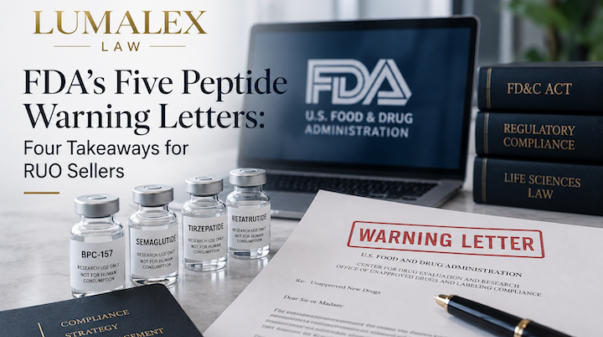
The July 2026 PCAC Peptide Meeting

On July 23 and 24, 2026, the FDA’s Pharmacy Compounding Advisory Committee, known as PCAC, met at the agency’s White Oak campus in Silver Spring,

Send Us A Message

Liliana Rivero | Lumalex Law

Liliana Rivero

Paralegal

With more than 15 years of professional experience, Liliana Rivero serves as a Paralegal and Administrative Assistant at LumaLex Law, where she provides comprehensive support to the firm’s attorneys and clients throughout every stage of the legal process. Recognized for her attention to detail, organization, and client-first approach, Liliana helps ensure matters are handled efficiently while delivering the responsive, high-quality service clients expect.

Raised in South Florida, Liliana earned her Associate of Arts in Paralegal Studies and her Bachelor of Arts in Criminal Justice. Throughout her career, she has worked across a broad range of industries and legal practice areas, including real estate, civil litigation, criminal defense, business law, and hospitality. This diverse background has given her a well-rounded perspective, exceptional organizational skills, and the ability to adapt to the unique needs of each client and matter.

Liliana believes that every step of her professional journey has prepared her for her current role. Her experience across multiple disciplines has strengthened her ability to anticipate challenges, communicate effectively, and support complex legal matters with professionalism, precision, and care.

At LumaLex Law, Liliana is proud to be part of a forward-thinking boutique law firm that values innovation, collaboration, and practical legal solutions. She is passionate about contributing to a team where achieving exceptional results is matched by an unwavering commitment to integrity, professionalism, and outstanding client service.

Bianca Lindau | Lumalex Law

Bianca Lindau

Senior Associate

Bianca Lindau is a Senior Associate at LumaLex Law, where her practice focuses on corporate transactions, venture financings, and commercial agreements for technology, healthcare, and emerging-industry clients. She regularly advises founders and growth-stage companies on entity formation, governance, M&A, and the negotiation of complex commercial contracts, including SaaS agreements, technology licenses, and joint development agreements.

Bianca brings nearly four years of transactional experience to her practice, having previously served as an Associate at a boutique corporate and IP law firm, where she advised technology companies and startups on a broad range of corporate and commercial matters, including stock purchase agreements, investor rights agreements, SAFEs, and IP-centric licensing and acquisition agreements. Her work has also touched on the evolving legal landscape around generative AI, including published writing on the topic and collaboration with companies developing AI-enabled legal tools. Bianca holds an LLM from Cornell Law School, where she was awarded the Cantwell Prize for Exemplary Student Research and a CALI Award in Contracts. She earned her German law degree (Diplom-Juristin) from Humboldt University Berlin and a Diploma in Legal Studies from King’s College London. She is admitted to practice in both Massachusetts and California. A native speaker of English, Spanish, and German, with proficiency in French, Bianca brings a global perspective to her work with clients and counterparties across jurisdictions. Outside the office, Bianca is an avid traveler who has visited every continent except Antarctica, and she is always seeking out new experiences, whether a new restaurant, unexpected hobbies, or an unfamiliar destination. She also enjoys staying active, channeling her creative side through needlepoint and clothing design, and spending time with her dog.

Ian Horowitz

Ian Horowitz

Of-Counsel
States Licensed: FL

Mr. Horowitz focuses his practice on estate planning, taxation, and business related matters, with advanced proficiency in estate, gift, federal income, and generation-skipping transfer taxation. His extensive knowledge in these areas enables him to craft tailored strategies that optimize tax efficiency and safeguard his clients’ assets. From crafting straightforward wills to designing complex domestic and foreign trusts, his commitment to preserving wealth and ensuring asset protection is unwavering.

In addition to his prowess in estate planning, Mr. Horowitz serves as a trusted advisor to businesses of all sizes from formation to sale assisting with drafting purchase and sale agreements, limited liability operating agreements, or other corporate documents. His counsel on entity formation and tax-efficient structures empowers entrepreneurs and corporations to make informed decisions that drive growth and prosperity.

Mr. Horowitz possesses a wealth of experience in international tax matters. He offers invaluable guidance to foreign clients navigating inbound business and real estate transactions in the United States. He is also recognized for his efficiency in helping individuals become bona fide residents of Puerto Rico under IRC Section 937. This specialized knowledge in tax strategies related to Puerto Rico’s unique tax laws positions him as a sought-after advisor for those seeking to take advantage of the favorable tax incentives offered by Puerto Rico.

Aggeliki Psonis

Aggeliki Psonis

Associate
States Licensed: NY, NJ. MA

A graduate of Boston University, with a JD from CUNY law school, Aggeliki focuses her practice on real estate transactions, estate planning and administration, business law and general litigation. She has extensive experience representing buyers, sellers, investors and business owners based in New York and internationally.

Aggeliki is admitted in the states of New York, New Jersey and Massachusetts, as well as in the Eastern and Southern Districts of New York. She is also a licensed Real Estate broker. She is a proud member of the Inspiring Women in Law League (IWILL) and the Hellenic Lawyers Association. She speaks fluent Greek and conversational French and Spanish. Aside from lawyering, she enjoys being a radio producer and performing artist.

Dallas Robinson, Of-Counsel

Dallas Robinson

Of-Counsel
States Licensed: FL


Dallas Robinson is an AV Preeminent-rated trial attorney who has dedicated his practice to representing injured people throughout Florida. Dallas has litigated and tried many different types of personal injury cases in numerous courthouses and venues in Florida. Dallas believes in prosecuting personal injury cases in a professional and aggressive manner, and has a clear track record of success in obtaining great financial compensation for his clients either through verdicts or settlements. Many lawyers advertise ‘trial experience,’ but have actually never seen the inside of a courtroom. Dallas has spent his entire career in the courtroom and litigating cases. This gives Dallas the real and true experience that it takes to strike fear in the hearts of insurance companies and obtain top financial compensation for his injured clients.


Dallas grew up in South Florida and attended Boston University where he played quarterback and defensive back for Boston University’s football team. Dallas graduated in 4 years with bachelor degrees in Classical Civilizations and History. He went straight to law school and attended University of Miami (FL) School of Law. Dallas graduated in 2002 with a Juris Doctorate degree and immediately passed the Florida Bar.


Dallas began his legal career representing businesses and insurance companies in workers’ compensation and personal injury cases. This gave him unique insight into exactly how insurance companies work and how they value cases. After achieving a high level of success in litigating these cases, Dallas moved on to representing the injured. Since that time, Dallas has obtained tens of millions of dollars in compensation for his clients through settlements and trial verdicts. Dallas is a member of the Multi-Million Dollar Advocates Forum which is an association of attorneys who have won seven-figure verdicts and settlements on behalf of their clients. This group is one of the most prestigious organizations for trial lawyers in the United States as fewer than 1% of U.S. lawyers have qualified as members.


In addition to great results for his clients, Dallas has also gained the respect of his peers for his ethics, ability, and professionalism. Dallas has received the highest level of distinction of an AV ® rated attorney by Martindale-Hubbell, which recognizes Dallas as possessing “Very High-Preeminent” legal ability with “Very High” ethical standards.

Yisroel Szpigiel, Of-Counsel

Yisroel Szpigiel

Of-Counsel States Licensed: NY, NJ  
Yisroel Szpigiel is a NY/NJ corporate attorney focused on outside general counsel and commercial transactions. With nearly a decade of experience managing law firms, he represents entrepreneurs, investors, and some of New York’s largest real estate developers in matters ranging across the full business lifecycle– from entity formation and early stage growth to day-to-day commercial contracting to complex financings, acquisitions, and strategic exits. He has closed over $100 million in transactions and is known for practical, business-first legal guidance that protects clients while keeping deals moving. 
 
Since joining LumaLex Law as Managing Partner January 2025, Yisroel has grown the firms Commercial Transactional and Real Estate Practices, and has started the firms MSO practice, focusing on private equity healthcare rollups. Yisroel is best known as a “problem solver”, with the ability to turn complex problems into workable solutions. He was twice named as a Super Lawyers New York Rising Star in 2024 and 2025, in the practice areas of Business Law, Real Estate, Mergers and Acquisitions, and Plaintiff’s Personal Injury.

In addition to his work with LumaLex Law and serving as trusted outside counsel to businesses in a wide range of industries, he has been recognized by community leaders with citations and awards. Yisroel earned his undergraduate degree from Rutgers University and his J.D. from Hofstra University School of Law, where he later returned as an adjunct professor. Outside the office, he enjoys golf, pickleball, and traveling with his wife and three children. 
Tom Dean | Of-Counsel

Tom Dean

Of-Counsel 
States Licensed: AZ


Tom Dean has been an attorney advocate for nationwide cannabis policy reform for over 25 years. As Legal Director for the National Organization for the Reform of Marijuana Laws (NORML) he initiated, managed, and litigated important cannabis related cases of national importance to the cannabis industry/community. In that capacity, he also coordinated the efforts of the NORML Legal Committee (lifetime member) and NORML Amicus Committee (former chair) in key cases throughout the U.S.  In 2015 the organization recognized his successful advocacy by inducting him into the NORML Distinguished Counsel’s Circle. He remains an active member of the NORML Legal Committee.

In 2016, Tom received the President’s Commendation award from the Arizona Attorneys for Criminal Justice (AACJ). In 2020, Tom received a Lifetime Achievement Award from the Errl Cup, a medical marijuana event producer which includes Arizona’s premier cannabis awards festival (30,000 attendees this year).

In 2021, Tom received Mikel Weiser Lifetime Achievement Award from Arizona’s Marijuana Industry Trade Association (MITA). Most recently, in 2023, Tom was honored by NORML with its Al Horn Award, which the organization awards to an attorney each year to in “recognition of a lifetime of ceaseless work to advance the cause of justice” in cannabis law.

Tom was a founding member of the Arizona Cannabis Bar Association (ACBA), an organization that seeks to educate lawyers and the public of the many unique aspects of cannabis law and emerging cannabis related areas of practice. He continues to serve on the board of ACBA. Outside of his practice, Tom enjoys, among other things, presenting at cannabis related seminars and conferences for lawyers and the public.

Josh Sanderlin | Of Counsel

Joshua Sanderlin

Of Counsel
States Licensed: MD, D.C.

Joshua Sanderlin is an experienced cannabis attorney and government affairs expert barred in Maryland and the District of Columbia. He has worked in the cannabis industry since 2013. At that time, he was an attorney and lobbyist at a large, global law firm. His experience working with clients in the earliest legal cannabis market in the U.S. sparked his interest in the field and motivated him to leave big law for the world of cannabis.

Since then, he has served as a lawyer and consultant to clients working in markets across the country, including seven states and the District of Columbia. His experience has given him a wide breadth of knowledge on issues touching the industry and, just as importantly, expanded his network to include experts from all across the industry. Having worked on cannabis issues in a variety of settings, Joshua understands that the industry is best served by specialized services.

Edgar J. Asebey | Of Counsel

Edgar J. Asebey

Of Counsel
States Licensed: FL, D.C.


Edgar J. Asebey is a regulatory and transactional attorney with over two decades of experience in federal regulation of pharmaceutical, biotechnology, medical device, food, dietary supplement and cosmetics companies. Since 2015, he has been working on Cannabis-related matters and transactions and since 2018 he has provide regulatory compliance, business transactional, venture finance and international trade services to hemp/CBD companies. Edgar brings a wealth of knowledge and over 20 years of experience to life science, Cannabis and hemp/CBD clients who require novel solutions to complex issues.

Edgar practices before the Food and Drug Administration (FDA), United States Department of Agriculture (USDA), Customs and Border Protection (CBP), Environmental Protection Agency (EPA), and the Federal Trade Commission (FTC), representing client companies on regulatory compliance, product approval/registration and FDA enforcement defense matters. He also assists clients with international and domestic business transactions, IP licensing, venture finance, trademark protection and import/export matters.

Edgar studied molecular biology at the University of Chicago and spent 5 years working in molecular biology research laboratories at the University of Chicago and the University of Illinois.  Early in his career he served as a Patent and Licensing Advisor to the Natural Products Branch of the National Cancer Institute at the National Institutes of Health (NIH).  He founded and served as president of Andes Pharmaceuticals, Inc., a natural products drug discovery company, from 1994 to 2000 and has served as in-house counsel to two life sciences companies. Most recently he was an equity partner in the Health Care & Life Sciences Practice Group at Jones Day. Edgar is currently a partner at Keller Asebey Life Science Law, PLLC.

While Edgar holds licenses to practice law in Florida and Washington, D.C. he can represent clients on federal regulatory matters in all 50 states.  He is a member of the American Bar Association (Section on Administrative Law & Regulatory Practice: Food and Drug Committee and International Committee), Food & Drug Law Institute (FDLI), Dade County Bar Association, and BioFlorida.

Dan Miller Head-Shot | Of-Counsel

Dan Miller

Of-Counsel
States Licensed: CA

Dan Miller, Esq., with over 15 years of experience in cannabis law and a growing expertise in psychedelics, is a staunch advocate for honoring both traditional and evolving regulated uses of these substances. A Vermont Law School alumnus (Class of 1998), he holds a J.D. and a Master’s in Environmental Law and Policy.

Before his foray into the world of entheogenic medicines, Dan honed his skills as a trial attorney with a focus on both criminal and civil cases. His passion for and in-depth understanding of cannabis and psychedelic substances redirected his career path, leading him to develop a niche practice area that has since become his hallmark.

Dan’s role in the cannabis industry is not just as a lawyer, but as a partner in his clients’ endeavors. He oversees all aspects of business development, from structural planning and licensing to adapting to dynamic legal landscapes. His strategic insights have been key in securing licenses, operational planning, and facilitating interstate business growth.

Dan continues to serve as outside general counsel for various businesses, leveraging his litigation background to offer comprehensive legal advice.

As the legal landscape continues to evolve, Dan Miller remains a steadfast and knowledgeable advocate, committed to bridging the gap between traditional use and modern regulatory frameworks in the world of cannabis and psychedelics.

States Licensed: CA

Christina Jaramillo | Junior Associate

Christina Jaramillo

Junior Associate
States Licensed: FL, CA

Christina Jaramillo is an Associate Attorney at LumaLex Law and an active member of The Florida Bar. Christina’s primary focus has been in the practice area of business transactions. Christina has legal experience drafting and reviewing various sales and services agreements, completing entity filings and EIN applications, drafting corporate governance documents and business plans, preparing franchise disclosure documents, drafting and reviewing commercial and residential lease agreements, assisting with mergers and acquisitions, preparing demand letters, working on estate plans and probate matters, and trademarks. Prior to joining LumaLex Law, Christina led the estate planning department at The Law For All, P.A.

Christina is the daughter of two Latinx immigrants, the youngest of five siblings, and the first member of her immediate family to graduate from college. In 2017, after just three short years on campus, Christina received her Bachelor of Science in Political Science, magna cum laude, from Florida State University, where she also minored in Economics. Christina received her Juris Doctor, magna cum laude, from the University of Miami School of Law in 2020.

While attending the University of Miami School of Law, Christina received several honors: Christina was nominated to serve as one of two Articles & Comments Editors for the University of Miami International and Comparative Law Review; Christina was a recipient of the Dean’s Certificate of Achievement Award, which is awarded to the top one or two students in the course, in Legal Communications & Research II; and Christina made the Dean’s List twice.

During her time in law school, Christina served as a Fellow and Blog Editor for the Professional Responsibility and Ethics Program (PREP), an intern for the Human Rights Clinic, and a Civil Procedure Dean’s Fellow. Christina was active on campus and engaged in her community because she understood the value in connecting with those around her and serving the needs of her community, which remains true today.

In her free time, Christina can be found at her local comic book shop or vegan bakery. Christina loves to read, stay up to date on popular television shows and movies, watch soccer, and occasionally jog.

Andy Sick | Partner

Andy Sick

Partner
States Licensed: NY, NJ, MI, CT

Andy Sick has been advising businesses, startups, and entrepreneurs for nearly 15 years. He assists clients through every stage of the business life cycle from incorporation and initial growth phases, to maturity with ongoing general counsel services including regulatory compliance and critical commercial transactions, and dissolution. Licensed to practice in New York, New Jersey, and Connecticut, Andy is the attorney responsible for the firm’s practice in these states.

At Mr. Cannabis Law, Andy represents various cannabis-related businesses on such matters as corporate structuring, licensing, and financing. He navigates clients through the constantly changing sea of cannabis rules and regulations. Andy handles marijuana license applications, business plans, and operating procedures for dispensaries, cultivators, nurseries, manufacturers, distributors, wholesalers, delivery services, and testing facilities. For the firm’s hemp industry clients, Andy helps obtain hemp licenses and maintain compliance with federal and state regulations. In the psychedelic space, Andy has served as a legal advisor to numerous non-profits, companies, and organizations including such groups as Decriminalize Nature and the Native American Church.

Andy began his legal career at boutique law firms serving as outside general counsel to businesses and representing clients in complex commercial litigation. Whether representing a three-person video game startup or a multinational spent nuclear fuel storage company, Andy worked directly with company presidents and other executives to develop and implement corporate legal strategies. Subsequently, he founded several startups, including a legal technology company that adapted artificial intelligence and virtual reality for use in the law. In addition to working with Mr. Cannabis Law, Andy has his own law firm, Sick Legal, which provides business and commercial transactional services to a range of clients.

During law school, Andy worked at the U.S. Justice Department’s Office of Consumer Litigation, the U.S. Attorney’s Office for the Northern District of New York, and for President Joe Biden when he served on the U.S. Senate Judiciary Committee

Andy is responsible for firm operations in New York, New Jersey, Michigan, and Connecticut 

Amanda Barton | Partner

Amanda Barton

Partner
States Licensed: FL

Amanda Barton is an active member of the Florida Bar and is admitted to practice in all U.S. District Courts and U.S. Bankruptcy Courts within the state of Florida.  Amanda has over ten years of legal experience handling complex corporate matters, with a strong focus on corporate governance, corporate finance, and regulatory compliance.  As someone who loves written language, Amanda excels in drafting and negotiating a vast array of legal documents.

Prior to joining LumaLex Law, Amanda had unique legal opportunities that have made her a well-versed, seasoned transactional business attorney.  Previously, she led the transactional department at The Law for All, P.A., where she assisted business clients with strategic business structuring, mergers and acquisitions, asset protection, business succession planning, and contract drafting, including companies involved in the cannabis and hemp industry.  She served as senior in-house counsel for an alternative financing company, where she built a legal department that leveraged technology, data analysis, and innovative resolution and recovery strategies.  Amanda also served as in-house counsel to a private investment firm, where she handled all in-house transactions with a concentration in Debtor-in-Possession financing for Chapter 11 debtors, secured lending transactions, fund management, and various aspects of municipal bond financing.

Amanda currently volunteers her time to serve as the President of the Broward County chapter of CannabisLAB, a networking and education group for professionals who are in or are looking to get involved in the cannabis marketplace.

Dustin Robinson | Managing Partner

DUSTIN ROBINSON

Founding Partner
States Licensed: FL

Dustin Robinson is the Founding Partner of LumaLex Law. Licensed in Florida as an Attorney, Certified Public Accountant, and Real Estate Agent, Robinson brings a rare, fully integrated legal–financial–business perspective to every engagement. His practice focuses on corporate structuring, regulatory strategy, transactions, capital formation, and high-stakes commercial litigation for growth-stage and emerging-market companies across a wide range of industries.

Before launching LumaLex Law, Robinson trained at two of the world’s most respected professional services firms—Deloitte and Holland & Knight—where he developed deep technical grounding in tax, corporate law, and complex commercial matters. He then left traditional practice to become an operator himself, applying his legal and accounting background to help run a multi-state manufacturing company that he helped grow to nearly $50 million in revenue. That experience shaped his core philosophy: great legal advice must be practical, entrepreneurial, and grounded in the realities of building and scaling real businesses.

Robinson is not only an advisor to entrepreneurs—he is one. In addition to LumaLex Law, he is the founder of multiple ventures, including Iter Investments , a venture capital fund backing frontier technologies and next-generation healthcare platforms; and Nucleus, a venture studio focused on launching digital and data-driven assets in emerging markets. Across his legal and investment platforms, Robinson has worked with founders operating in biotech, neurotech, telehealth, psychedelics, cannabis, fintech, real estate, digital media, AI-driven platforms, and other highly regulated or rapidly evolving sectors.

Widely regarded as a trailblazer in emerging industries, Robinson has played a leading role in shaping legal and commercial frameworks for novel business models long before they became mainstream. He has served as lead counsel in several high-profile commercial disputes, including the widely covered Shohei Ohtani 50–50 baseball litigation, and is frequently sought out for matters involving regulatory gray zones, innovative deal structures, and first-of-their-kind ventures.

Robinson also served on the Board of Directors of Clairvoyant Therapeutics, a biotechnology company that was advancing psilocybin-based treatments for alcohol use disorder through FDA clinical trials. He has advised and represented numerous venture-backed companies, founders, and investment vehicles operating at the intersection of science, technology, regulation, and capital markets.

Beyond legal practice and investing, Robinson is deeply involved in thought leadership and ecosystem-building. He created and moderates a long-running monthly panel series at Soho Beach House Miami, convening founders, physicians, scientists, investors, and cultural leaders to discuss innovation, wellness, and frontier technologies. Past guests have included NBA Champion Lamar Odom, NHL star Daniel Carcillo, and other prominent figures across business and entertainment.

Robinson has been regularly profiled and featured as an expert in major media outlets, including Bloomberg News, Forbes, The Wall Street Journal, INSIDER, VICE, The Miami Herald, Authority Magazine, Thrive Global, Benzinga, and others. He is a frequent speaker at global industry conferences and private founder and investor forums.

A triple Gator, Robinson earned his Bachelor’s in Accounting, Master’s in Accounting, and Juris Doctor from the University of Florida.

Today, Robinson’s work sits at the intersection of law, entrepreneurship, and capital formation. He is known for helping founders think bigger, structure smarter, and move faster—while staying compliant, investable, and defensible. His mission is simple: to help entrepreneurs build category-defining companies in industries that don’t yet have a playbook.