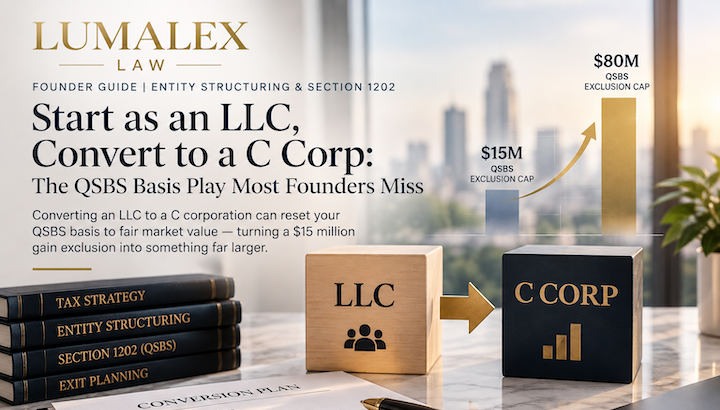
Founder Guide | Entity Structuring & Section 1202
Converting an LLC to a C corporation can reset your QSBS basis to fair market value, turning a $15 million gain exclusion into something far larger. Here are the mechanics, the math, and when it actually works.
The Short Version
Most founders treat “LLC or C corp” as a one-time decision made at formation. It is not. It is a sequence. If you build inside an LLC, take your early losses personally, grow the business to real value, and then convert to a C corporation, Section 1202 measures your QSBS basis using the fair market value of the business on the day you convert, not the few thousand dollars you originally put in.
The QSBS exclusion cap is the greater of $15 million or 10 times your basis. A founder who incorporates on day one with a $50,000 basis is capped at $15 million. A founder who converts an LLC worth $8 million is capped at $80 million.
The trade: the holding-period clock starts at conversion. An LLC interest never had one, and the appreciation you earned before converting never becomes excludable. This only pays if you keep building for years after the conversion.
First, QSBS in Ninety Seconds
Section 1202 lets non-corporate taxpayers exclude gain on the sale of qualified small business stock.
Following the One Big Beautiful Bill Act, for stock issued after July 4, 2025:
- 3-year hold — 50% of gain excluded
- 4-year hold — 75% excluded
- 5+ year hold — 100% excluded
- Per-issuer cap — the greater of $15 million, indexed for inflation for tax years beginning after 2026, or 10x your aggregate adjusted basis
- Company size ceiling — aggregate gross assets of $75 million or less at all times before, and immediately after, the stock is issued
Stock issued on or before July 4, 2025 keeps the old rules: a flat five-year hold, a $10 million cap, and a $50 million asset ceiling. To qualify, the issuer must be a domestic C corporation, you must have acquired the stock directly from the company at original issuance, and at least 80% of the company’s assets must be used in an active qualified trade or business for substantially all of your holding period.
A long list of businesses simply do not qualify: health, law, accounting, consulting, financial services, brokerage, athletics, performing arts, hospitality, farming, and any business where the principal asset is the reputation or skill of its employees. Businesses holding significant investment real property are also out.
If you are in an excluded field, stop here. No amount of structuring fixes it. LLC membership interests are never QSBS. That is the entire reason this conversation exists.
What a Conversion Does to Your QSBS Position
When you convert an LLC into a corporation, you are, for federal tax purposes, contributing the LLC’s assets to a corporation in exchange for its stock. That is a Section 351 exchange, generally tax-free where the contributing owners hold at least 80% control of the corporation immediately after. Section 1202(i)(1)(B) then does two specific things to the stock you receive.
1. Your QSBS Basis Is Deemed to Equal the Fair Market Value of the Property Contributed
Not your historical carryover basis. Fair market value on the conversion date. Thus, the 10x basis cap could be theoretically much higher if your company’s valuation has increased between inception to conversion.
2. Appreciation That Accrued Before the Conversion Is Not Eligible for Exclusion
The deemed-FMV basis applies for Section 1202 purposes only. Your real basis for computing actual gain is still carryover. The built-in gain that existed on conversion day therefore sits outside the exclusion and is taxable at ordinary long-term capital gains rates when you sell.
3. The Holding Period Starts at Conversion
The stock is issued at conversion. That is day one for the 3/4/5-year tiers. Your time in the LLC does not tack. Membership interests are not stock, so there was never a Section 1202 clock running to preserve.
The Math
Assume a founder capitalizes a business with $100,000 and builds it into a $60 million exit over eight years. In Path B, the business is independently valued at $8 million at year three, when the founder converts.
|
Path A — C Corp Day One |
Path B — LLC, Convert at Year 3 |
|
|
Initial capital |
$100,000 |
$100,000 |
|
QSBS basis |
$100,000 actual |
$8,000,000 deemed FMV |
|
Exclusion cap |
$15,000,000 |
$80,000,000, 10x |
|
Sale price, year 8 |
$60,000,000 |
$60,000,000 |
|
Gain excluded |
$15,000,000 |
$52,000,000 |
|
Gain taxed |
$44,900,000 |
$7,900,000 |
|
Approx. federal tax |
~$10.7 million |
~$1.9 million |
Difference: roughly $8.8 million. Figures assume a 23.8% federal rate, 20% long-term capital gains plus 3.8% net investment income tax, on non-excluded gain and ignore state tax.
Two real-world adjustments improve Path B further. First, basis in the LLC interest grows each year by profits taxed but not distributed, shrinking the pre-conversion taxable slice. Second, during the LLC years, operating losses flowed to the founder’s personal return instead of being trapped as corporate NOLs.
When This Works
- You are bootstrapping first, raising later. Early losses do more good on a K-1 than stranded inside a corporation.
- Your LLC is profitable but cash-hungry. Members owe tax on their distributive share whether or not a dollar is distributed. A founder reinvesting every dollar of profit can end up writing personal tax checks on income that never left the business. A C corporation retains those earnings at 21% without pushing phantom income onto its owners.
- The business has real, defensible value at conversion. The 10x lever does not engage until fair market value clears $1.5 million. Below that, the $15 million floor governs either way.
- You are well under $75 million in gross assets. Under Section 1202(d)(2)(B), contributed property counts at fair market value for the asset test. Convert too late and you fail the size ceiling outright.
- You expect to hold at least five more years after converting. Three years gets 50%. Four gets 75%. The full exclusion requires patience.
- You are in a qualifying industry. Software, products, manufacturing, technology, consumer brands. Not professional services.
- Institutional capital is on the horizon anyway. If a VC will require a Delaware C corp eventually, doing it deliberately beats doing it under a term-sheet deadline.
When It Does Not
- You distribute most of your profits every year. Converting turns those distributions into dividends, taxed twice. QSBS is worth nothing to a business that never sells.
- Your industry is excluded from Section 1202. Health, law, consulting, financial services, hospitality, farming, and real-estate-heavy businesses.
- You are selling in the next two years. The clock starts at conversion and you would reach no tier. A Section 1045 rollover into replacement QSBS may be the better lever.
- The LLC carries debt in excess of basis. Section 357(c) can force gain recognition on the conversion itself. Leveraged entities need this modeled before anything is filed.
- You are not selling, ever. A permanent operating business you intend to hold and draw income from is usually better off as a pass-through.
How the Conversion Actually Happens
In Florida, the cleanest route is a statutory conversion under Fla. Stat. §§ 605.1041–605.1046. One filing, one entity, continuous legal existence. No dissolution, no asset transfer documents, and no gap in your contracts, licenses, or bank relationships.
- Get a defensible valuation as of the conversion date. This is the single most important document in the file. It sets your deemed QSBS basis, and it is what the IRS will test if you ever claim a 10x cap. Use an independent appraisal prepared contemporaneously, not a spreadsheet you made.
- Confirm eligibility before filing. Qualifying industry, gross assets under $75 million counted at fair market value, and no redemption activity that could taint the issuance.
- Adopt a plan of conversion satisfying both Chapter 605 and your operating agreement. Many operating agreements impose their own approval thresholds, and those control where valid.
- File with the Division of Corporations along with the new corporation’s articles of incorporation. Florida’s cover form for an LLC converting into another entity type is CR2E106. The effective date can be set up to 90 days out, which is useful for aligning with a valuation date or tax year.
- Convert membership interests into stock per the plan, and paper the stock side properly: bylaws, board and shareholder consents, a stock ledger, share certificates or book-entry records, and 83(b) elections filed within 30 days on any restricted stock. Holders of profits interests need particular attention. Their economic entitlement at conversion drives both their share of stock and their basis.
- Confirm EIN treatment with your tax advisor. Practice is genuinely split here. Because a state-law statutory conversion continues the same legal entity, many practitioners retain the existing EIN, and there are real costs to a new number where licenses and registrations are tied to it. But IRS guidance directs a partnership that incorporates to obtain a new EIN. Decide deliberately and document the reasoning.
- Handle the tax filings: a short-year final Form 1065 for the partnership, a first Form 1120 for the corporation, and Section 351 statements attached to the returns.
- Build the QSBS file and keep it forever. Valuation, cap table at issuance, gross asset calculations at and immediately after issuance, and annual documentation of the 80% active business test. QSBS is claimed years later, often by a buyer’s diligence team first. Contemporaneous records are the difference between a clean exclusion and a fight.
A Note on the Check-the-Box Alternative
You can also elect corporate tax treatment on Form 8832 and leave the LLC intact under state law. That is a deemed Section 351 contribution and works for many purposes. But Section 1202 requires stock, and practitioners disagree about whether membership interests qualify even when the entity is taxed as a corporation. If QSBS is the point of the exercise, convert to an actual corporation. Do not build an eight-figure tax position on an unresolved question.
A Note on Delaware
If venture capital is coming, converting directly into a Delaware corporation is generally preferable to converting in Florida and redomesticating later. Florida’s statute permits conversion into a foreign entity, and Delaware permits an LLC to convert in, so this can usually be accomplished in a single step. The mechanics and filing sequence should still be confirmed for your facts.
Five Things That Quietly Kill the Strategy
- No contemporaneous valuation. A basis you cannot substantiate is a cap you cannot claim.
- Redemption activity around the conversion. Section 1202(c)(3) contains two separate traps. Stock is disqualified if the corporation redeems from the holder or a related person during a four-year period beginning two years before issuance. Separately, any issuance is disqualified if the corporation makes redemptions exceeding 5% of aggregate stock value during a two-year period beginning one year before issuance. Narrow de minimis exceptions apply, as do carve-outs for death, disability, divorce, and termination of employment. Whether a pre-conversion buyout of a member is counted is not free from doubt, which is precisely why buying out a departing member near a conversion deserves its own analysis.
- Crossing $75 million in gross assets. Contributed property counts at fair market value. The ceiling is tested at issuance, and it is unforgiving.
- Holding the stock in the wrong hands. Section 1202 is available to individuals, trusts, and estates, not corporations. If your holding entity is a corporation, the exclusion evaporates.
- Living in a non-conforming state at the exit. Florida has no personal income tax, which makes this clean here. California, Pennsylvania, Alabama, and Mississippi do not follow Section 1202, and the District of Columbia decoupled at the end of 2025. New Jersey moved into conformity beginning in 2026. Where you live when you sell matters, and conformity changes.
The Point
Entity selection is not a formation task you complete once and forget. It is a sequence you run against a timeline: pass-through while you are losing money and finding product-market fit, corporate once the business has value and a five-year horizon in front of it.
Done deliberately, the conversion turns your own hard-won enterprise value into tax basis, and tax basis is what unlocks the largest gain exclusion in the code.
Done late, or without a valuation, or in the wrong industry, it does nothing at all. LumaLex Law works with founders on entity structuring, LLC-to-C-corp conversions, and QSBS planning.
If you are weighing whether and when to convert, schedule a consultation and we will model it against your actual timeline.
This article is for general informational purposes and is not legal or tax advice. Section 1202 is fact-intensive and unforgiving, and the rules described here continue to develop as guidance is issued under the 2025 amendments. Outcomes depend on your specific circumstances. Consult qualified counsel before acting.