By Dustin Robinson, JD, CPA | Founding & Managing Attorney, LumaLex Law | November 2026
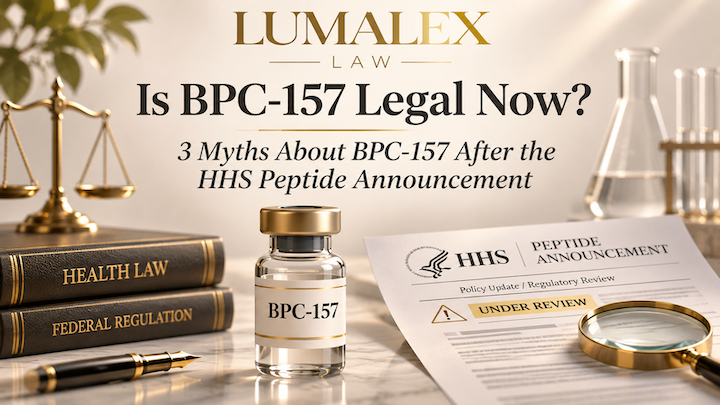
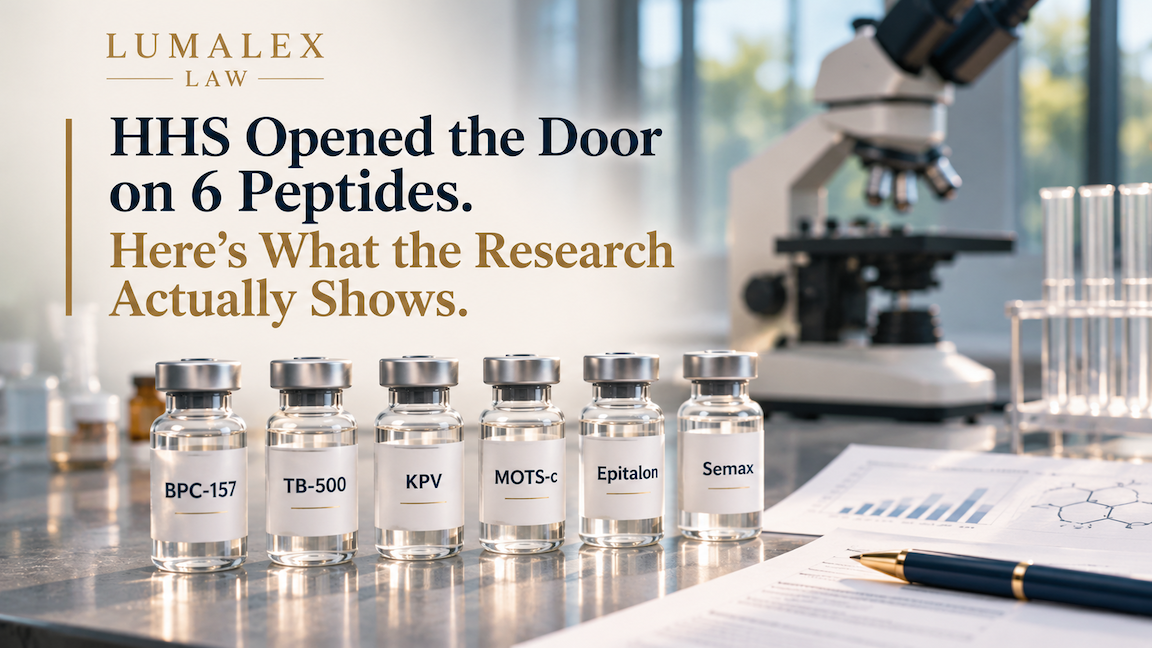
BPC-157. TB-500. KPV. MOTS-c. Epitalon. Semax. On October 28, 2026, HHS announced it won’t take enforcement action against licensed 503A pharmacies that compound these six peptides, as long as they meet ten strict conditions. By the next morning, half the internet had decided they were “approved.”
They’re not. And before anyone decides whether one of these compounds is worth taking, prescribing, or building a business around, there’s a more basic question to answer: what does the research actually show?
I come at this from two angles. As an attorney, I represent compounding pharmacies, telehealth companies, and peptide businesses. I’m also the General Partner of Iter Investments, a fund that invests in clinical trials, so I read the evidence the way a funder has to: what’s been proven in humans, what’s only been shown in animals, and what’s never been tested at all. I love peptides. That’s exactly why the facts matter to me.
No hype. No fear. Just the studies.
Key Takeaways
- Compounded drugs are not FDA-approved. FDA doesn’t review them for safety, effectiveness, or quality before they’re sold.
- None of the six has ever been approved in the U.S. Unlike most compounded drugs, there’s no approved version backed by full clinical trials.
- All six have animal data. None has a large randomized, placebo-controlled trial in the form being compounded under the HHS policy.
- Absence of evidence cuts both ways. No study shows these peptides work in humans, but no study shows they don’t. We need real trials.
First: What a Compounded Drug Actually Is
A compounded drug is a medication a licensed pharmacy prepares for an individual patient under a prescription. Compounding exists for good reasons. Maybe a patient is allergic to an inactive ingredient, or needs a dose or form that isn’t commercially available.
But compounded drugs aren’t FDA-approved. FDA doesn’t review them for safety, effectiveness, or quality before they reach patients.
Here’s the part most people miss. The vast majority of compounded drugs are versions of medications that were approved after full clinical trials. Compounded semaglutide, for example, traces back to the large trials behind Ozempic and Wegovy. The pharmacy is compounding a molecule whose safety and effectiveness were already established.
These six peptides are different. None of them has ever been approved in the United States, in any form. There’s no approved version and no completed U.S. clinical trial program behind them. The research described below is all the evidence there is.
Some people call compounded peptides “experimental.” Legally, that’s not quite right, and the truth is more striking. An experimental (investigational) drug is used in an FDA-cleared clinical trial, with oversight, informed consent, and data collection. Compounded peptides have none of that. They aren’t even experimental. An experiment collects data. This doesn’t.
How to Read the Evidence
Not all research is equal. Here’s the ladder, from weakest to strongest:
- Testimonials. Personal stories. Great for generating questions, useless for answering them.
- Cell and test-tube studies. They show a compound does something biologically, not that it helps a person.
- Animal studies. Important, but most compounds that work in rodents fail in humans.
- Small human studies without controls. These can show a signal, but they can’t rule out placebo effects, bias, or chance.
- Randomized, double-blind, placebo-controlled trials. The gold standard. Patients are randomly assigned, neither they nor the researchers know who got the real drug, and the results are compared to placebo.
As you’ll see, most of these six peptides stop at step 3 or 4.
The Six Peptides, One by One
1. BPC-157 (“the Wolverine peptide”)
- Animal research: Extensive, with hundreds of preclinical papers. A 2025 systematic review of BPC-157 in musculoskeletal healing included 36 studies, and 35 of them were in animals.
- Human research: Three small pilot studies, about 30 people in total: a retrospective knee pain study (16 patients followed), an interstitial cystitis study (12 patients), and an IV safety study of just 2 healthy adults. None had a control group.
- Randomized trials: None published. A 42-person randomized, placebo-controlled Phase I trial was registered in 2015 (NCT02637284), then cancelled with no results released. Two early colitis trials in the 2000s were reported only as conference abstracts.
- Safety: FDA has said it “lacks sufficient information to know whether the drug would cause harm when administered to humans,” citing possible immunogenicity and impurity concerns. Animal toxicology studies haven’t identified a toxic dose.
- Bottom line: Promising in animals. Unproven in humans.
2. TB-500
- What it is: A short synthetic fragment (seven amino acids) of thymosin beta-4, a naturally occurring 43-amino-acid protein. The HHS policy covers the fragment.
- Animal research: Rodent studies report faster healing of skin wounds, tendons, and fractures.
- Human research: We found no published human trials of TB-500 itself.
- The catch: The human trials people often cite for TB-500 actually tested full-length thymosin beta-4, a different and much larger molecule, given as eye drops (RGN-259). A Phase 3 dry eye trial (ARISE-3) didn’t meet its primary endpoints. A small randomized, double-masked trial in neurotrophic keratopathy reported complete healing in 6 of 10 treated patients versus 1 of 8 on placebo.
- Bottom line: The human data people point to is borrowed from a different molecule, given a different way.
3. KPV
- What it is: A three-amino-acid fragment of alpha-MSH, a hormone involved in inflammation.
- Animal and lab research: Roughly 15 to 20 cell and mouse studies, mostly in colitis models and largely from a single research group. Oral KPV reduced colitis in mice.
- Human research: We found no published human trials.
- Bottom line: An interesting anti-inflammatory signal in mice. No human data.
4. MOTS-c
- What it is: A peptide encoded by mitochondrial DNA, first described in 2015.
- Animal research: In mice, MOTS-c prevented diet-induced obesity and insulin resistance.
- Human research: No published trials of native MOTS-c. A modified analog, CB4211, completed a small randomized, double-blind, placebo-controlled Phase 1b trial: 20 adults with obesity and fatty liver, treated for 4 weeks. Liver enzymes (ALT and AST) and glucose improved versus placebo. But liver fat, the main target, fell by about the same amount on placebo (about 5.0% versus 4.9%). These were company-reported topline results.
- Bottom line: The only real trial tested a different version of the molecule, briefly, in 20 people.
5. Epitalon
- What it is: A synthetic four-amino-acid peptide based on epithalamin, a pineal gland extract developed in Russia.
- Animal and lab research: In one mouse study, average lifespan didn’t change significantly, though maximum lifespan rose about 12%. The “anti-aging” claims largely trace back to cell studies showing increased telomerase activity in lab dishes.
- Human research: About four small human studies, mostly from one research network in St. Petersburg, some with overlapping participants. Blinding is unclear or missing. Older mortality claims involve epithalamin, a chemically different extract.
- Bottom line: A 2026 narrative review summed it up: “biologically active but clinically unproven.”
6. Semax
- What it is: A synthetic peptide derived from ACTH, registered as a drug in Russia. It isn’t approved by FDA or the European Medicines Agency.
- Human research: Russian stroke studies with roughly 110 to 187 patients, where Semax was given on top of standard treatment. These studies were controlled, but not randomized and not placebo-controlled. No independent Western trials have been published.
- Cognitive claims: We found no published studies of Semax as a cognitive enhancer in healthy people. That claim comes from rat research.
- Bottom line: The most human data of the six, but none of it meets modern trial standards.
The Scorecard
|
Peptide |
Animal studies |
Human studies |
Randomized, placebo-controlled trials |
|
BPC-157 |
Yes, extensive |
About 30 people across 3 pilot studies |
None published |
|
TB-500 |
Yes |
None of TB-500 itself |
None (trials used full-length thymosin beta-4 eye drops) |
|
KPV |
Yes, mostly mouse colitis |
None found |
None |
|
MOTS-c |
Yes |
None of native MOTS-c |
One 20-person, 4-week trial of a modified analog |
|
Epitalon |
Yes, mixed |
About 4 small studies, mostly one group |
No adequately powered trial |
|
Semax |
Yes |
Russian stroke studies (110 to 187 patients) |
None; studies were not randomized or placebo-controlled |
Not one of the six has a large randomized, placebo-controlled trial in the form being compounded.
What FDA’s Own Scientists Said
At FDA’s July 2026 Pharmacy Compounding Advisory Committee meeting, the agency’s review staff recommended against adding these peptides to the list of substances pharmacies may compound, citing concerns about characterization, impurities, and immunogenicity. The advisory committee voted to recommend several of them anyway, and HHS went on to adopt an enforcement discretion policy. That policy is a draft and interim, which means it can be revised or withdrawn.
It also doesn’t change state law. State boards of pharmacy and medical boards can still restrict these peptides or act against pharmacists and prescribers. If you’re in this business, the federal policy is a floor, not a green light. (For more, see our breakdown of BPC-157 myths after the HHS announcement.)
The Flip Side: No Evidence Is Not Proof of Harm
It would be just as wrong to say these peptides don’t work or are dangerous. No study shows that. In several cases, animal toxicology hasn’t identified a toxic dose, and the small human studies that exist reported positive signals.
The honest answer is: we don’t know. Not because these compounds failed, but because nobody has done the work.
We Need Real Trials
Millions of people are interested in these compounds. Use is rising fast, and regulators are opening the door. What’s missing is evidence: properly designed, randomized, placebo-controlled human trials that tell patients and doctors what works, at what dose, and at what risk.
My fund, Iter Investments, invests in clinical trials. That’s the gap we want to see closed. Until it is, anyone using, prescribing, or selling these peptides should be clear-eyed about what’s known and what isn’t.
Frequently Asked Questions
Are BPC-157, TB-500, KPV, MOTS-c, Epitalon, and Semax FDA-approved?
No. None of the six is FDA-approved. The HHS policy is enforcement discretion for licensed 503A compounders that meet ten conditions. It isn’t approval.
Have any of these peptides been tested in randomized clinical trials?
Not in the form being compounded. The only randomized, placebo-controlled human data involve a modified MOTS-c analog (20 people, 4 weeks) and full-length thymosin beta-4 eye drops. Those are different molecules from what’s being compounded.
Which of the six has the most human research?
Semax, based on Russian stroke studies. Those studies weren’t randomized or placebo-controlled.
Does a lack of research mean these peptides are unsafe?
Not necessarily. It means safety and effectiveness haven’t been established in humans. No study shows they’re harmful, and none shows they’re safe and effective.
Are compounded peptides experimental drugs?
Not legally. Investigational drugs are used in FDA-cleared clinical trials with oversight and data collection. Compounded peptides are prescribed outside of any trial, so no systematic data is collected.
Can a pharmacy compound these peptides in any form?
No. The HHS policy specifies forms and routes for each peptide. Semax, for example, is covered only as an intranasal product, and KPV only as topical or oral. TB-500, MOTS-c, and Epitalon are covered only as injections. Blends aren’t covered.
Talk to a Peptide Attorney
LumaLex Law advises compounding pharmacies, telehealth platforms, med spas, and peptide companies on FDA and state compliance, supply chain structuring, marketing review, and enforcement response. If you’re building in this space, contact us to schedule a consultation.
Disclaimer: This article is for general informational purposes only and is not legal or medical advice. Reading it does not create an attorney-client relationship. Research summaries reflect published and publicly reported information as of November 2026 and may be incomplete. Consult qualified counsel about your specific situation and a licensed healthcare provider before using any peptide. Attorney advertising.