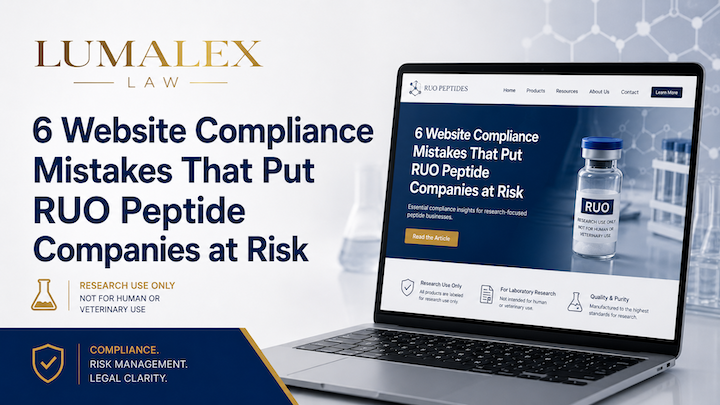
For an RUO peptide company, the website is not just a marketing tool. It is often the first place a regulator, payment processor, or plaintiff’s attorney will look to understand how the business is presenting its products.
That matters because an “RUO” label alone does not protect a company. Under FDA’s intended-use framework, regulators and courts look at the total picture, not only the disclaimer. Homepage language, product names, checkout flow, follow-up emails, and support responses can all be used to argue that a company selling research-use-only products is really operating like a consumer retail business for products not approved for human use. For RUO peptide companies, compliance is not about one perfect disclaimer. It is about consistent signals across the entire website.
1. Homepage Messaging
The homepage sets the tone for the rest of the site. If the language feels aspirational, outcome-based, fitness-focused, or wellness-adjacent, it can weaken the RUO position before a visitor ever reaches a product page.
A footer disclaimer cannot fix a homepage that reads like a supplement store. RUO companies should review the first impression their site creates and remove language that suggests human use, performance benefits, or consumer wellness outcomes.
2. Product Pages
Product pages are usually one of the highest-risk areas on an RUO peptide website. Each product page should stand on its own with clear, prominent disclaimer language near the product description, not buried below the fold or left only in a site-wide footer.
Product names also matter. Names that imply energy, focus, fat loss, recovery, performance, or similar effects can undercut an RUO position, even if the product page includes a disclaimer.
The question to ask is simple: if a regulator looked only at this product page, would it read like a research chemical listing or a consumer product page?
3. Site-Wide Footer Disclaimer
A site-wide footer disclaimer is still important. It should appear consistently across the website and reinforce that products are not for human or animal consumption and have not been evaluated by the FDA.
But a footer disclaimer is only a baseline layer. It should support the compliance structure, not carry it alone.
4. Entry Acknowledgment and Terms and Conditions
Passive browsing can create risk. Stronger RUO websites often require visitors to affirmatively acknowledge the research-use-only nature of the products before accessing the shop.
That acknowledgment should be tied to Terms and Conditions that are easy to find and understand. It should not be buried in a footer link where users can move through the site without ever seeing it.
5. Checkout Flow
Checkout is one of the most commonly overlooked control points. A homepage may be clean, the product pages may be careful, and the footer may include the right disclaimer, but if a customer can purchase without acknowledging research-only intent, the site still has a gap.
A required checkbox, not pre-checked, can help document that the buyer understood the RUO nature of the products and agreed to the Terms and Conditions before completing the purchase.
6. Post-Purchase Experience
Compliance risk does not end once the order is placed. Order confirmation emails, support responses, follow-up marketing, and other post-purchase communications can all be reviewed later.
If those communications sound inconsistent with the RUO position, they can weaken the work done elsewhere on the site. The message should remain consistent from entry gate to checkout to follow-up.
Why One Disclaimer Is Not a Strategy
The strongest RUO peptide websites do not rely on one disclaimer buried in the Terms and Conditions. They use layered messaging across the entry gate, footer, product pages, checkout flow, and post-purchase communications. A single disclaimer is a statement. A consistent website experience is a compliance position.
Common Red Flags on RUO Peptide Websites
Several patterns tend to create additional risk, especially when they appear together. These include loyalty programs, volume discounts, “bulk deal” language, bacteriostatic water sold alongside peptides, limited buyer verification, consumer-style pricing, heavy social media marketing, and proprietary product names with no scientific basis. One issue may not decide the entire analysis, but regulators and payment processors usually look at the pattern, not one factor in isolation.
Why Website Compliance Matters Beyond FDA Risk
Website compliance mistakes can create FDA and FTC exposure, but they can also create business disruption before a regulator ever gets involved.
A site that reads as consumer-facing may be flagged by a payment processor’s risk team, leading to account freezes or shutdowns. For RUO peptide companies, a website review is not only about regulatory risk. It is also about keeping the business operational.
FAQ
What is an RUO peptide?
An RUO peptide is a research-use-only peptide. It should be positioned for research purposes, not for human or animal consumption.
Is an RUO disclaimer enough to protect a peptide company?
No. An RUO disclaimer is important, but regulators and courts look at the totality of the circumstances, including product names, homepage copy, checkout flow, emails, and other marketing.
What are common website compliance mistakes for RUO peptide companies?
Common compliance mistakes include consumer-style homepage language, product names that imply human outcomes, buried disclaimers, no entry acknowledgment, no checkout acknowledgment, and inconsistent post-purchase messaging.
Why do payment processors care about RUO peptide website compliance?
Payment processors may flag websites that appear consumer-facing or inconsistent with RUO positioning. That can lead to account freezes or shutdowns before a regulator takes action.
The Bottom Line
There is no single fix that makes an RUO peptide website compliant. The safer approach is a system of consistent signals across the homepage, product pages, footer, entry gate, checkout flow, Terms and Conditions, and post-purchase communications.
Generic templates copied from another site can do more harm than good if they do not match the company’s actual products, marketing, and business model.
LumaLex Law conducts RUO website compliance reviews for peptide companies, evaluating homepage language, product pages, disclaimers, entry flow, checkout, and related website materials against current FDA, FTC, and FDCA risk considerations. The goal is to identify specific issues and provide practical remediation recommendations before those issues become enforcement or payment-processing problems. Contact us today to schedule a consultation!
Disclaimer: This article is provided for general informational purposes only and does not constitute legal advice or create an attorney-client relationship. Telehealth and healthcare rules vary by state and change frequently. Consult qualified counsel about your specific facts.