If you sell research-use-only peptides, you have probably been asked for a Safety Data Sheet by a distributor, payment processor, freight carrier, or customer compliance department. Some RUO peptide sellers treat the SDS as a box to check, a PDF added to the website to look legitimate, but that is a mistake. A properly drafted Safety Data Sheet is one of the clearest ways an RUO company can show that it is operating as a research chemical supplier, not as an unlicensed seller of products for human use.
An SDS does not make a peptide FDA-approved. It does not mean the product is safe for human use. It belongs to a separate workplace and transportation safety framework. But for RUO peptide companies, it can still be an important part of a broader compliance program.
What Is a Safety Data Sheet?
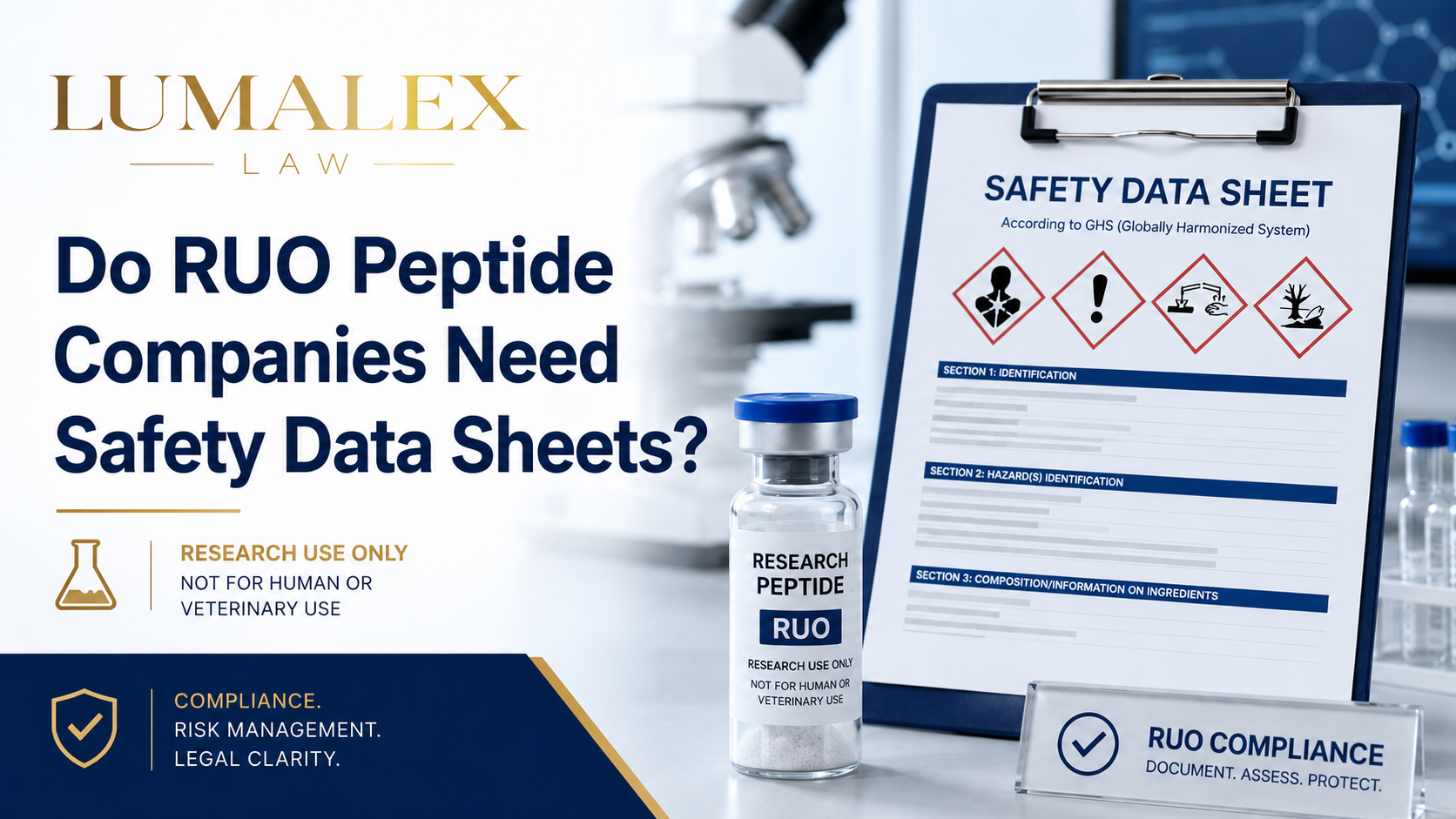
A Safety Data Sheet is a standardized document that communicates chemical hazards, handling requirements, and emergency information.
In the United States, SDS format and content requirements come from OSHA’s Hazard Communication Standard, also called HazCom, at 29 CFR 1910.1200. HazCom aligns with the Globally Harmonized System of Classification and Labelling of Chemicals, often called GHS.
HazCom applies to manufacturers, importers, and distributors of hazardous chemicals in the workplace. Peptides sold for research use fall within this framework because they are chemical substances being distributed to purchasers. If a company manufactures, imports, repackages, or distributes peptide products, it is functioning as a chemical distributor for HazCom purposes.
That means SDS and labeling rules matter.
What an SDS Does Not Do
An SDS should never be used to suggest that an RUO peptide is safe for human use, approved by the FDA, or appropriate for therapeutic use.
This is a separate requirement from FDA drug and dietary supplement regulation. The SDS exists to communicate workplace and transportation safety information. It should support the research-chemical positioning of the product, not turn into a marketing document.
Why Safety Data Sheets Matter for RUO Peptide Companies
RUO peptide companies operate in a regulatory environment where the biggest legal risk is often not chemical hazard. It is misbranding and unapproved new drug liability under the Federal Food, Drug, and Cosmetic Act.
The products may be lawful to sell as research chemicals, but the risk comes from how the company markets, labels, documents, and presents them.
What a Compliant SDS Should Cover
A strong SDS supports the RUO position in a few practical ways. It reinforces that the product is being handled as a chemical, not a drug. It gives distributors, freight carriers, payment processors, and customer compliance teams documentation they may need to continue working with the company. It also creates a paper trail showing that the business took its compliance obligations seriously. A missing SDS, or a generic one copied from an unrelated source, does the opposite.
Under GHS and HazCom, every SDS follows the same 16-section format. For RUO peptide products, several sections need real attention rather than boilerplate:
- Identification
This should include the product identifier, supplier information, and a recommended use such as “laboratory research use only, not for human or veterinary use.” - Hazard Identification
This should reflect the actual GHS classification for the specific substance. Generic peptide SDS templates often overstate or understate hazards because they were not reviewed against the actual peptide. - Composition/Ingredient Information
This should include the CAS number where available, purity, and any excipients or buffers included in the formulation. - First-Aid Measures
This should include accurate exposure response information. It should not include language that reads like dosing, administration, or human-use guidance. - Handling and Storage
This should describe laboratory-appropriate handling and storage conditions, including relevant temperature, light sensitivity, or reconstitution hazards. - Exposure Controls/Personal Protection
This should provide PPE recommendations appropriate for a research chemical handled in a lab setting. - Transport Information
This should address information required for freight and carrier compliance, since shipping partners may request it before accepting peptide shipments.
Common SDS Compliance Mistakes
One of the most common mistakes is using the same SDS across an entire product catalog with only the product name changed. That can create inaccurate hazard classifications, molecular data, or first-aid instructions. In some cases, a bad SDS may be worse than no SDS because the company has provided documentation it is effectively certifying as accurate.
Other common mistakes include treating the SDS as a marketing document, using it to imply purity or safety for use, failing to provide product-specific documentation, creating inconsistencies between the SDS, product label, and website, and having no process to update the SDS when formulation, sourcing, or classification changes.
Consistency matters. If the SDS says “not for human use” but the website suggests dosing or human outcomes, the company has created conflicting evidence.
How SDS Compliance Fits Into a Larger RUO Program
An SDS is only one part of a broader compliance structure. A stronger RUO compliance program may also include a pre-entry age and purpose gate, RUO-specific Terms and Conditions, product naming and labeling that avoid drug-like claims, and a corporate structure that separates manufacturing, ecommerce, and IP functions.
None of these pieces work well in isolation. A strong SDS cannot fix marketing copy that promises fat loss or muscle growth. Clean marketing cannot fix an SDS that looks copied from the wrong molecule.
Some companies building or auditing SDS libraries at scale use automated generation tools calibrated to peptide-specific hazard data. That may help reduce templating problems, but any output should still be reviewed against the company’s actual labeling and marketing before it goes live.
FAQ
Do RUO peptide companies need Safety Data Sheets?
Yes, if the company manufactures, imports, repackages, or distributes the product, OSHA’s Hazard Communication Standard requires an SDS that follows the GHS 16-section format.
Does an SDS mean a peptide is FDA-approved?
No. A Safety Data Sheet addresses workplace and transportation hazard communication. It does not mean the product is FDA-approved or safe for human use.
Can one generic SDS be used for all peptide products?
Not safely. Hazard classification, first-aid measures, composition information, and other details should reflect the specific peptide.
Who is responsible for SDS accuracy?
The distributing company is ultimately responsible for the accuracy of the SDS it provides. Technical tools may assist with generation, but the final document should be reviewed for consistency with the company’s labeling and marketing.
The Bottom Line
RUO peptide companies should treat Safety Data Sheets as part of their compliance infrastructure, not as a cosmetic PDF. A proper SDS helps communicate chemical handling information, supports the company’s research-use-only positioning, and gives distributors, carriers, payment processors, and customers the documentation they often need.
The goal is not to make a therapeutic claim. The goal is to document the product accurately as a research chemical and keep the SDS consistent with the rest of the company’s labeling, website, and business model.
LumaLex Law advises RUO peptide companies on SDS, labeling, website compliance, and broader regulatory risk. If your company needs to review its SDS library or align its safety documentation with its RUO positioning, contact us to discuss the right next step.
Disclaimer: This article is provided for general informational purposes only and does not constitute legal advice or create an attorney-client relationship. Telehealth and healthcare rules vary by state and change frequently. Consult qualified counsel about your specific facts.