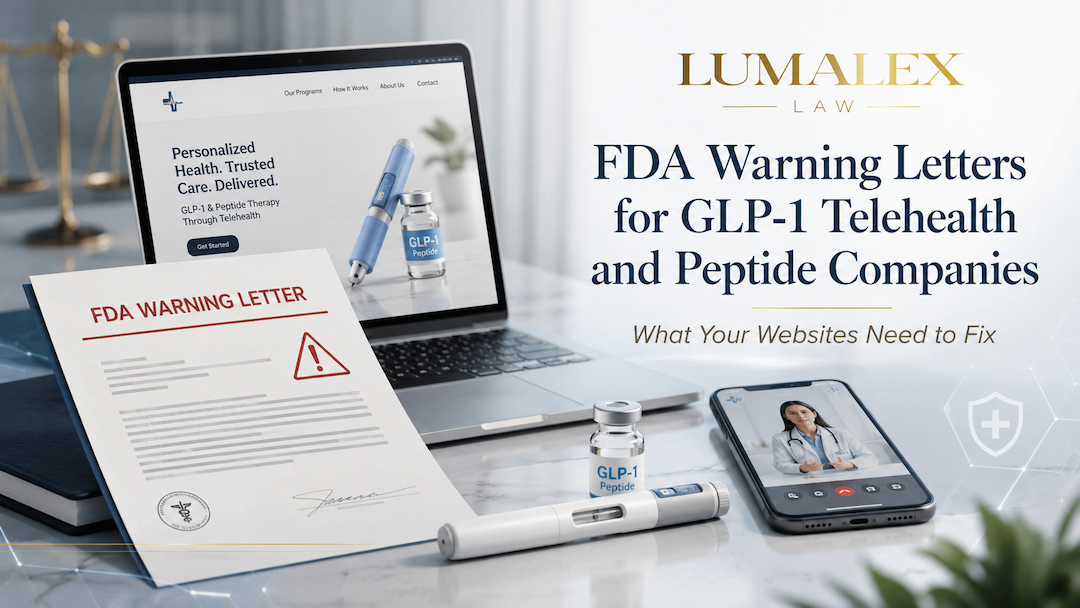
The FDA has sent an escalating number of warning letters to telehealth companies offering compounded GLP-1 medications and peptides since September 2025. The letters share a common theme: the FDA is looking closely at website language and using those claims as evidence of misbranding and unapproved new drug violations under the Federal Food, Drug, and Cosmetic Act.
For GLP-1 telehealth and telehealth peptides companies, the website is not something to set and forget. It is a compliance document. If the language suggests disease treatment, generic equivalence, misleading sourcing, or unsubstantiated health outcomes, the site itself can become the FDA’s evidence.
What the FDA Warning Letters Are Showing
FDA enforcement has escalated across several waves since September 2025 and accelerated through June 2026. Across those warning letters, the same types of issues keep appearing.
The FDA has cited misbranding under FDCA Sections 502(a) and 502(n), unapproved new drug status, private-labeling and sourcing claims, and “generic” positioning that suggests a compounded or branded peptide is functionally identical to a generic alternative.
The broader lesson is straightforward: the FDA is not only reviewing what products are being sold. It is reviewing how those products are described.
Red Flag #1: Disease Treatment and Therapeutic Claims
The clearest trigger is language suggesting that a product treats, cures, mitigates, prevents, or manages a disease. For GLP-1 and peptide telehealth companies, that can include claims tied to obesity, diabetes, cardiovascular disease, or similar health conditions.
Risk can also appear in less obvious places. A results page may connect weight loss to disease outcomes. A testimonial may imply disease treatment. A patient education page may describe therapeutic benefits in a way that crosses the line from information into drug claims. If a website says or implies that a product produces a disease-related outcome, it should be reviewed carefully.
Red Flag #2: Generic or Equivalence Claims
The FDA has repeatedly flagged language suggesting that a proprietary formulation, branded product, or compounded peptide is equivalent to an FDA-approved drug or can be treated as a generic version.
Problematic phrases include calling a product a “generic version” of an FDA-approved drug, saying a formulation is the same as a brand-name product, or presenting a compounded peptide as a cost-effective alternative without clearly disclosing its unapproved status.
For compounded GLP-1 telehealth and peptide businesses, comparison language can create serious risk if it suggests therapeutic equivalence.
Red Flag #3: Vague or Misleading Sourcing Language
The FDA has also scrutinized websites that use unclear sourcing or manufacturing language.
This can include “proprietary formulation” claims without explaining that the actual active ingredient is supplied by a third party under a private-label arrangement. It can also include broad phrases like “pharmaceutical-grade” or “trusted suppliers” without meaningful disclosure about who supplies the active pharmaceutical ingredients.
If testimonial language equates “our peptide” with a reference product without appropriate disclosure, that can also create problems. Transparency matters. Vague language can make a website look more misleading than the company may intend.
Red Flag #4: Unsubstantiated Health and Wellness Claims
Even softer wellness language can create risk if it is tied to a specific health outcome.
Claims like increased energy, improved focus, or other performance benefits may be risky when directed at people seeking medical treatment. Statements that a product is clinically proven to reduce weight within a certain timeframe can also create concern if the product lacks FDA approval or clear substantiation.
Patient testimonials can create the same issue, especially if they describe health improvements such as normalized blood sugar or other medical outcomes without appropriate disclaimers.
The issue is not only whether a claim uses the word “treat.” The issue is whether the overall message suggests a therapeutic or disease-related benefit.
What GLP-1 Telehealth and Peptide Websites Should Audit
A website audit should begin with the pages and sections most likely to be reviewed by the FDA.
The homepage and hero section should be checked for language suggesting treatment, cure, disease management, or prevention. Product pages should be reviewed for “generic,” “equivalent,” or branded-drug comparison claims. Results pages, before-and-after content, and testimonials should be evaluated for disease-treatment implications.
Companies should also review sourcing pages, FAQ sections, patient education content, pricing or comparison pages, blog articles, and any entry or gating mechanisms. If the website includes research-use-only or informational-use-only language, that language should appear before the user accesses detailed product information, not only after the user has already moved through the site.
Practical Website Remediation Principles
The goal of website remediation is not to make a site vague or unhelpful. It is to remove language that creates unapproved drug, misbranding, or misleading-equivalence risk.
Claims should be reframed away from therapeutic treatment language and toward compliant cosmetic, educational, or informational framing where appropriate. Disclaimers about product status, manufacturing source, and non-equivalence to FDA-approved drugs should be clear and prominent.
Sourcing and manufacturing relationships should be disclosed transparently. If a product is compounded, the site should say so clearly and explain what compounded means under federal law.
Testimonials should be limited to outcomes that do not imply disease treatment. Entry gates or disclaimers can help show intent, but they do not replace compliant product pages, claims, and website copy.
The Risk of Waiting
If the FDA sends a warning letter, the company has 15 business days to respond. After that, the path toward negotiated resolution, injunction, or seizure can move quickly.
Website remediation is far less expensive than enforcement. The cost of reviewing and revising claims is measured in hours or days of legal work. The cost of FDA enforcement can include legal fees, operational disruption, potential product seizure, and reputational harm.
For telehealth companies offering compounded GLP-1 medications, peptides, or related products, a website compliance review is not optional. It is risk management.
FAQ
What are FDA warning letters?
FDA warning letters are enforcement communications that identify potential violations and require companies to respond. For GLP-1 and peptide telehealth companies, recent letters have focused heavily on website claims.
Why does website language matter for GLP-1 telehealth companies?
Website language can be used as evidence of misbranding or unapproved new drug violations if it suggests disease treatment, therapeutic benefit, generic equivalence, or misleading sourcing.
What claims should telehealth peptide companies avoid?
Companies should avoid disease treatment claims, “generic” or “equivalent” claims, vague sourcing language, unsubstantiated health outcomes, and testimonials implying medical improvement.
What should a GLP-1 telehealth website audit include?
An audit should review homepage copy, product pages, testimonials, sourcing disclosures, comparison pages, FAQ content, blog posts, entry gates, disclaimers, and any educational material that could imply therapeutic claims.
The Bottom Line
The FDA warning letters to GLP-1 telehealth and peptide companies show that website language matters. Disease claims, generic-equivalence claims, vague sourcing language, and unsubstantiated wellness claims can all create risk under the FDCA.
Companies should review the site before the FDA does. That means auditing homepage copy, product pages, testimonials, sourcing disclosures, comparison language, educational content, entry gates, and disclaimers.
LumaLex Law has analyzed and remediated websites for GLP-1 and peptide telehealth companies across FDA warning letter waves. Our team provides attorney-client privileged reviews identifying specific claims that need revision, proposed language, and the regulatory reasoning behind each recommendation.
If your company operates a telehealth platform offering compounded GLP-1 medications, peptides, or related products, schedule a consultation today with LumaLex Law to discuss a website compliance review.
Disclaimer: This article is provided for general informational purposes only and does not constitute legal advice or create an attorney-client relationship. Telehealth and healthcare rules vary by state and change frequently. Consult qualified counsel about your specific facts.