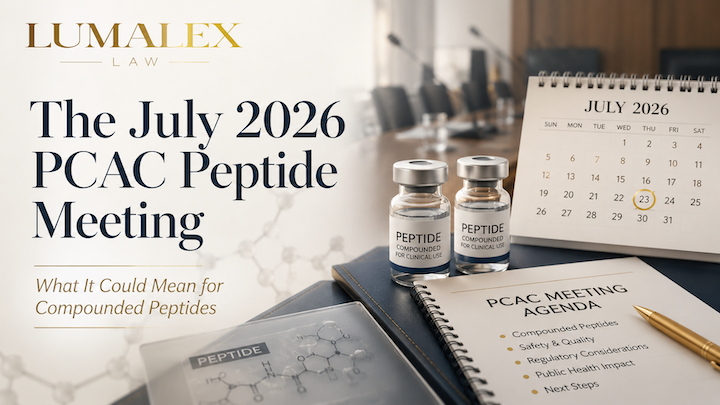
On July 23 and 24, 2026, the FDA’s Pharmacy Compounding Advisory Committee, known as PCAC, met at the agency’s White Oak campus in Silver Spring, Maryland to consider whether seven peptides should be added to the Section 503A Bulk Drug Substances List. For anyone operating in the peptide, telehealth, or compounding space, this was one of the most important compounding-law meetings in years.
The meeting matters because the 503A Bulks List helps determine which bulk substances state-licensed pharmacies may lawfully use to compound medications for individual patients. But it is also easy to overstate what this meeting can do. A committee vote is not a rule. Being added to the 503A Bulks List is not the same thing as being moved to Category 1. And none of these outcomes is the same as FDA drug approval.
That distinction is where many businesses get into trouble. We explain how the industry got here, what the committee reviewed, what the vote means, and what peptide, telehealth, and compounding-adjacent businesses should understand before making decisions based on the headlines.
How We Got Here
The July 2026 meeting is the result of a multi-year regulatory process. Beginning in 2023, FDA placed roughly nineteen peptides into Category 2 of its interim 503A bulk-substances framework. Category 2 is the designation FDA uses for nominated substances that raise significant safety questions and that the agency does not intend to permit in compounding while review is underway.
FDA cited concerns that included immunogenicity, impurity profiles, and limited human clinical data for many of the substances. In practice, the Category 2 designation removed a broad group of widely used peptides from the legitimate compounding supply chain, which redirected demand toward gray and black markets.
Then, on February 27, 2026, Health and Human Services Secretary Robert F. Kennedy Jr. publicly signaled an intent to reverse course, indicating that a substantial majority of the restricted peptides, roughly fourteen of the nineteen, should move back toward legal compounding access.
That announcement created expectations across the industry, but it did not change any peptide’s legal status on its own. A Cabinet statement is not a rule, and it is not a revision to the 503A Bulks List.
The concrete regulatory steps came later. In April 2026, the companies that had originally nominated a group of these peptides withdrew their nominations. FDA then announced on April 15, 2026, with a Federal Register notice on April 16, that twelve peptides would come off the Category 2 list effective April 23, 2026. At the same time, the FDA scheduled the July 23–24 PCAC meeting and opened a public docket FDA-2025-N-6895 for written comments.
That sequence created a lot of confusion. Coming off Category 2 does not mean a peptide has been placed in Category 1. It also does not mean the peptide has been added to the 503A Bulks List. Removal from Category 2 lifted a specific “do-not-compound” posture. It did not affirmatively authorize compounding. The affirmative authorization question is what the July meeting, and the rulemaking process that must follow, is about.
What the FDA Briefing Materials Signal
Ahead of an advisory committee meeting, FDA publishes briefing materials explaining how the agency evaluates each substance against the statutory criteria. Those criteria include whether the substance is well-characterized, whether there are safety concerns, the historical use of the substance in compounding, and the available evidence of effectiveness.
For this meeting, FDA’s briefing materials reflect a cautious agency posture. The materials emphasize gaps in human safety and effectiveness data and characterization concerns for several of the nominated peptides.
That does not determine the outcome. FDA staff evaluation and the committee’s vote are separate. The committee can agree, disagree, or reach a more nuanced result. But the agency’s cautious posture is important for anyone trying to read the meeting realistically.
What PCAC Reviewed
The committee reviewed seven peptides across two days, each in both free-base and acetate salt forms. The question for each substance was narrow: should this bulk drug substance be added to the Section 503A Bulk Drug Substances List?
On July 23, 2026, the committee reviewed:
- BPC-157 for tissue repair and gastrointestinal indications
- KPV for anti-inflammatory indications
- TB-500, also known as thymosin beta-4 fragment, for wound healing and tissue repair
- MOTS-C for metabolic and mitochondrial-function indications
On July 24, 2026, the committee reviewed:
- Emideltide, also known as DSIP or delta sleep-inducing peptide, for opioid withdrawal, chronic insomnia, and narcolepsy
- Semax for cerebral ischemia, migraine, and trigeminal neuralgia
- Epitalon for longevity and bioregulator indications
At the meeting, FDA presented its evaluation, nominators had the opportunity to make short presentations supporting their nominations, the public had a chance to comment, and the committee discussed and voted on whether each substance should be included on the list.
What Happened at the Meeting and Results
Over the two days, FDA presented its evaluation of all seven peptides: BPC-157, KPV, TB-500, and MOTS-C on Day One, July 23, and emideltide (DSIP), Epitalon, and Semax on Day Two, July 24. Each substance was reviewed in both free-base and acetate form, following an open public hearing session before each substance.
FDA staff maintained throughout that none of the seven substances were well-characterized and that human safety and effectiveness data were insufficient for any of them. The nominators had withdrawn their formal nominations in April, and FDA proceeded to evaluate all seven substances on its own initiative.
The committee ultimately broke from FDA’s cautious posture. Six of the seven substances were recommended for inclusion on the 503A Bulks List in both free-base and acetate form: BPC-157, KPV, TB-500, MOTS-C, Epitalon, and Semax. Emideltide (DSIP) was the lone exception and was recommended against inclusion.
As with any PCAC vote, none of this is self-executing. The vote is advice to FDA, and FDA must still proceed through notice-and-comment rulemaking before anything is formally added to, or kept off, the 503A Bulks List.
| Peptide | Committee Recommendation | Vote |
| BPC-157 | Recommend inclusion | 8–6–1, both free base and acetate |
| KPV | Recommend inclusion | 8–6–1, both free base and acetate |
| TB-500 | Recommend inclusion | 8–6–1, both free base and acetate |
| MOTS-C | Recommend inclusion | 7–5–2, both free base and acetate |
| Emideltide (DSIP) | Recommend against inclusion | 6–7–1, both free base and acetate |
| Semax | Recommend inclusion | 8–5–1, both free base and acetate |
| Epitalon | Recommend inclusion | 7–4–1, both free base and acetate |
Why the Committee Vote Is Important, But Not Final
PCAC is a federal advisory committee that gives FDA scientific, technical, and medical advice on compounding questions under Sections 503A and 503B of the Federal Food, Drug, and Cosmetic Act.
The committee is authorized to include up to twelve voting members, including a chair, with expertise in pharmaceutical compounding, pharmaceutical manufacturing, pharmacy, and medicine. Its structure is designed to include representation from the National Association of Boards of Pharmacy, the United States Pharmacopeia, practicing compounding pharmacists, physicians with compounding experience, and patient or public-health advocacy organizations.
The most important point is that the committee’s role is advisory only.
FDA often accepts advisory committee recommendations, but it is not required to do so. Whatever the committee voted on July 23-24, FDA makes the ultimate decision, and the agency must do that through rulemaking.
What Happens Next
Regardless of how the committee votes, the same basic process comes next.
First, the committee’s vote is a recommendation, not a final decision. FDA can accept it, modify its approach, or decline to follow it.
Second, FDA must complete notice-and-comment rulemaking to actually add a substance to the 503A Bulks List or formally decline to add it. That means FDA, in consultation with USP, must publish a proposed rule, take public comment, consider those comments, and then publish a final rule. The 503A Bulks List is codified by regulation at 21 C.F.R. § 216.23.
Third, the process has historically been slow. Of the hundreds of substances nominated over the years, only about ten have completed the process. Businesses planning around compounded peptides should not assume that July creates an immediate switch-flip moment.
FDA has also signaled a second PCAC meeting before the end of February 2027 to consider five additional peptides, reported to include GHK-Cu, Melanotan II, cathelicidin (LL-37), dihexa acetate, and pegylated mechano growth factor (PEG-MGF).
FDA could potentially place favorably viewed substances into Category 1 on an interim basis while rulemaking proceeds. However, this would require a change to their January 7, 2025 guidelines that essentially ended Category 1 for bulk drug substances nominated on or after January 7, 2025. Whether the agency chooses to do so is discretionary and remains one of the key issues to watch.
Could HHS Move Faster?
There is one possible wildcard. Section 503A(c) of the Federal Food, Drug, and Cosmetic Act includes a public-health provision that allows the Secretary of Health and Human Services to issue a regulation before consulting PCAC if doing so is necessary to protect public health.
That provision is often overstated. It can waive the advisory-committee consultation step, but it does not waive rulemaking. The 503A Bulks List is still codified by regulation, which means adding a substance to the list remains subject to the Administrative Procedure Act, including a proposed rule, public comment period, and final rule.
There are really two different levers here, and they should not be conflated. The first is the interim-category lever. Category 1, Category 2, and Category 3 are part of FDA’s interim enforcement policy, not the statutory bulks list itself. Moving a substance between interim categories is an enforcement-policy action. That is why the 2023 Category 2 placements and 2026 removals occurred without notice-and-comment rulemaking. HHS could plausibly move peptides into Category 1 on an interim basis relatively quickly, which could create practical compounding access in the near term. But that would still be interim policy, not the codified list.
The second is the actual bulks-list lever. Adding a substance to the 503A Bulks List is rulemaking. The public-health clause can speed the path by waiving PCAC consultation, but it cannot replace the rulemaking process.
Some commentators have argued that HHS could justify faster action by pointing to the unregulated research-use-only gray market. The theory is that keeping these peptides out of regulated compounding pushes demand into less controlled channels, and that bringing them into regulated pharmacy compounding would better protect public health.
As a policy argument, that theory is coherent. As a legal basis for using the 503A(c) override, it is more difficult. The public-health clause is about urgency of timing, not whether a substance meets the substantive standard for listing. A gray-market rationale may explain why faster action is needed, but it does not cure gaps in safety, effectiveness, or characterization evidence. It also uses a compounding-list mechanism to address what is fundamentally an enforcement problem involving misbranded and unapproved drugs sold as research chemicals. The faster lane is real, but it is not a shortcut around the legal standard.
What This Result Does Not Mean
This is where compliant operators need to be especially careful. The committee’s recommendations do not automatically make these peptides Category 1. They do not add anything to the 503A Bulks List by themselves. They are not FDA drug approval. They do not legalize research-use-only consumer sales. And they do not eliminate the need for a valid prescription and a licensed pharmacy.
Even if a substance is eventually listed, it may only be compounded by an appropriately licensed pharmacy pursuant to a valid prescription, subject to all other 503A requirements.
Nothing about this process changes the analysis for consumer peptide products marketed under an RUO label. The intended-use doctrine still applies, and a compounding-list development does not turn a consumer peptide operation into a lawful one.
FAQ
What is the July 2026 PCAC peptide meeting?
The July 23–24, 2026 PCAC meeting is an FDA advisory committee meeting where seven peptides are scheduled for review for possible inclusion on the Section 503A Bulk Drug Substances List.
Which peptides are being reviewed at the July 2026 PCAC meeting?
The seven peptides are BPC-157, KPV, TB-500, MOTS-C, emideltide (DSIP), Semax, and Epitalon, each in free-base and acetate salt forms.
Does a PCAC recommendation automatically authorize compounding?
No. PCAC recommendations are advisory. FDA must still act through rulemaking before a substance is added to the 503A Bulks List.
Is Category 1 the same as the 503A Bulks List?
No. Category 1 is part of FDA’s interim enforcement policy. The 503A Bulks List is the codified regulatory list at 21 C.F.R. § 216.23.
Does being added to the 503A Bulks List mean FDA drug approval?
No. Compounding eligibility and FDA drug approval are different regulatory statuses. None of these outcomes means a peptide has completed the clinical trial and new-drug-approval process.
Does this meeting legalize RUO peptide sales?
No. The meeting concerns compounded medications under Section 503A. It does not legalize consumer sales of research-use-only products, and the intended-use doctrine still applies.
The Bottom Line
The July 23-24 PCAC meeting was a real inflection point for peptide compounding, but its importance lies as much in what it starts as in what it decides. Six of the seven peptides under review were recommended for inclusion on the 503A Bulks List, while emideltide (DSIP) was recommended against inclusion.
That is a meaningful development for the peptide and compounding community, but it is not the end of the process. The actual legal change happens later through rulemaking. The difference between a committee recommendation, a Category designation, a 503A Bulks List entry, and FDA drug approval will continue to matter.
For peptide, telehealth, and compounding-adjacent businesses, the safest approach is to read the outcome carefully, avoid overclaiming what it means, and make business decisions based on the actual regulatory status, not the market narrative.
LumaLex Law advises peptide, telehealth, and compounding-adjacent clients on these issues. If you want to understand how the PCAC meeting may affect your specific model, contact us to discuss the regulatory path forward.
Disclaimer: This article is provided for general informational purposes only and does not constitute legal advice or create an attorney-client relationship. Telehealth and healthcare rules vary by state and change frequently. Consult qualified counsel about your specific facts.